Introduction
Choosing a music distributor is one of the most important decisions for any independent artist or record label.
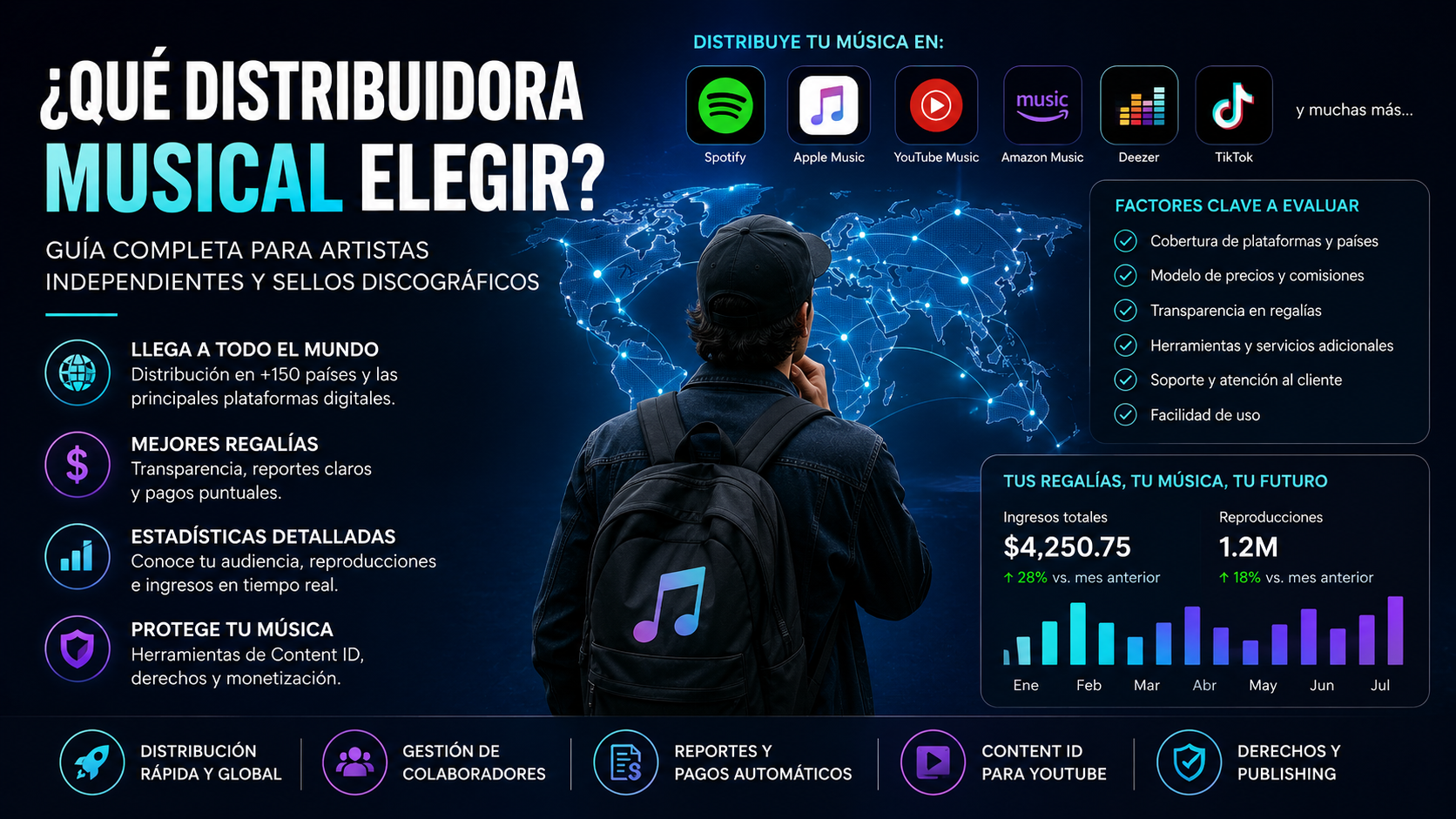
A distributor is responsible for delivering your music to platforms such as Spotify, Apple Music, YouTube Music, and TikTok, while also managing royalties, metadata, and, in some cases, additional monetization tools.
But with so many options available, an inevitable question arises:
Which music distributor should I choose?
The answer depends on your goals, budget, business model, and long-term needs.
In this guide, you'll find the most important criteria to make an informed decision and understand what differentiates one music distributor from another.
Table of Contents
- What does a music distributor do?
- Why is it important to choose the right distributor?
- Factors to consider when choosing a music distributor.
- Pricing models.
- Additional services.
- Advantages and disadvantages.
- Comparison criteria.
- Frequently Asked Questions.
- Summary.
What Does a Music Distributor Do?
A music distributor is a company or platform responsible for delivering music to digital services and managing the processes related to its commercialization.
Quick Definition
A music distributor connects artists and record labels with streaming platforms, manages metadata, and facilitates royalty collection and digital revenue management.
Its main functions include:
- Distributing music to digital platforms.
- Managing metadata.
- Collecting royalties.
- Managing catalogs.
- Providing analytics.
- Offering additional monetization tools.
Why Is It Important to Choose the Right Music Distributor?
Because not all distributors offer the same services.
Some focus on:
- Basic distribution.
- International coverage.
- Marketing tools.
- Publishing administration.
- YouTube monetization.
- Services for record labels.
Choosing the right platform can influence:
- Your revenue.
- Publishing speed.
- Access to new tools.
- Catalog management.
- The scalability of your music project.
Factors to Consider When Choosing a Music Distributor
Before making a decision, it is important to evaluate several aspects.
1. Available Platforms
Check whether the distributor delivers music to services such as:
- Spotify
- Apple Music
- YouTube Music
- TikTok
- Amazon Music
- Deezer
- Tidal
Key Question
Does the distributor provide coverage in the platforms and countries where your audience is located?
2. Global Coverage
Some distributors have a presence in:
- More than 100 countries.
- Emerging markets.
- Regional streaming platforms.
Others focus mainly on specific territories.
If you aim to build a global audience, this factor is essential.
3. Pricing Model
Music distributors generally operate under three pricing models.
| Model | How It Works | Advantages | Disadvantages |
|---|---|---|---|
| Subscription | You pay a recurring fee | Predictable costs | You must keep the subscription active |
| Commission | The distributor keeps a percentage of royalties | Lower upfront cost | Lower net income |
| Hybrid | Subscription + commission | More services | Can be more expensive |
There is no universally best model.
It depends on:
- Your release volume.
- Your current revenue.
- Your long-term strategy.
4. Royalty Transparency
A good distributor should provide:
- Clear reports.
- Payment history.
- Simple withdrawal methods.
- Detailed information by platform.
Important Question
Can I know exactly how much each song earns and how my income is calculated?
5. Analytics Tools
Statistics can help you:
- Identify countries where your audience is growing.
- Analyze song performance.
- Measure marketing campaigns.
- Make data-driven decisions.
Some platforms offer:
- Streams by country.
- Revenue by store.
- Audience demographics.
- Growth history.
6. Additional Services
Modern distributors often go beyond music delivery.
Some offer:
- YouTube Content ID.
- Publishing administration.
- Rights management.
- Licensing and synchronization.
- Royalty automation.
- Tools for record labels.
7. Customer Support
This aspect is often underestimated.
However, it can be crucial when:
- There is an issue with a release.
- Metadata errors occur.
- Technical support is required.
- You need assistance with royalties or rights.
Key Question
Does the platform provide fast and specialized support?
Comparison Criteria for Choosing a Music Distributor
| Criterion | Why It Matters |
|---|---|
| Global Coverage | Expands access to international markets |
| Available Platforms | Increases distribution reach |
| Royalties | Directly affects your income |
| Analytics | Helps decision-making |
| Content ID | Enables YouTube monetization |
| Publishing | Manages publishing rights |
| Support | Helps resolve issues |
| Scalability | Supports catalog growth |
Is There a Best Music Distributor?
There is no single answer.
The best distributor is the one that:
- Fits your needs.
- Offers the tools you require.
- Is transparent with royalties.
- Has a pricing structure that suits your business.
- Can grow alongside your music project.
Example
An artist who releases only a few singles per year may prioritize:
- Low cost.
- Simplicity.
- Fast publishing.
A record label will likely look for:
- Multi-artist management.
- Automatic royalty splits.
- Advanced tools.
- Specialized support.
What Are Independent Artists Looking for Today?
Current trends show that many artists value:
- Global distribution.
- Monetization across multiple platforms.
- Real-time analytics.
- Royalty transparency.
- Centralized management.
For this reason, platforms have emerged that integrate distribution, royalties, and monetization into a single ecosystem.
For example, some solutions such as UXEM aim to provide these tools to independent artists and record labels, enabling them to manage releases and monetization from a unified platform.
Advantages of Choosing a Good Distributor
Greater Reach
Your music can reach hundreds of millions of listeners worldwide.
Centralization
You can manage:
- Releases.
- Royalties.
- Analytics.
- Rights.
- Collaborators.
All from one place.
Scalability
You can grow from:
- A single.
- An EP.
- An album.
- An entire catalog.
Access to New Opportunities
Some distributors offer:
- Content ID.
- Publishing services.
- Synchronization opportunities.
- Promotional tools.
Potential Disadvantages
Costs
Depending on the model:
- Subscription fees.
- Commissions.
- Additional services.
Technological Dependence
Changing distributors may require:
- Catalog migration.
- Metadata updates.
- New administrative processes.
Differences Between Platforms
Not all distributors provide:
- The same support quality.
- The same delivery speed.
- Advanced tools.
- Equal international coverage.
Frequently Asked Questions (FAQ)
What Is the Best Music Distributor?
There is no universally best option.
The right choice depends on:
- Your goals.
- Your budget.
- The size of your catalog.
- The tools you need.
Do All Distributors Pay the Same Royalties?
No.
Royalties may vary depending on:
- Contracts.
- Commission structures.
- Included services.
- Commercial agreements.
Can I Change Distributors?
Yes.
Many artists migrate their catalogs when they find better conditions or new tools.
Do I Need a Distributor If I'm an Independent Artist?
In most cases, yes.
Major streaming platforms work through authorized distributors or aggregators.
Do Distributors Keep My Rights?
Not necessarily.
It depends on the contract.
Some distributors only manage music delivery, while others offer additional rights management and monetization services.
Summary
Choosing a music distributor is a strategic decision that can directly influence the growth of an artist or record label.
There is no universally better option.
The choice depends on factors such as:
- International coverage.
- Available platforms.
- Royalty transparency.
- Additional tools.
- Pricing.
- Technical support.
Understanding how distributors work and which criteria to evaluate allows artists and labels to make more informed decisions and build a sustainable strategy within the digital music industry.
Keep Learning
Music distribution is only one part of today's music ecosystem.
Topics such as royalties, YouTube Content ID, publishing, monetization, and release strategies are closely connected and can help you maximize the opportunities offered by the digital music economy.