Introduction
If you have released music or plan to distribute an album, EP, or single, you have probably heard about UPC.
This code is one of the most important elements in digital music distribution because it allows a release to be uniquely identified worldwide.
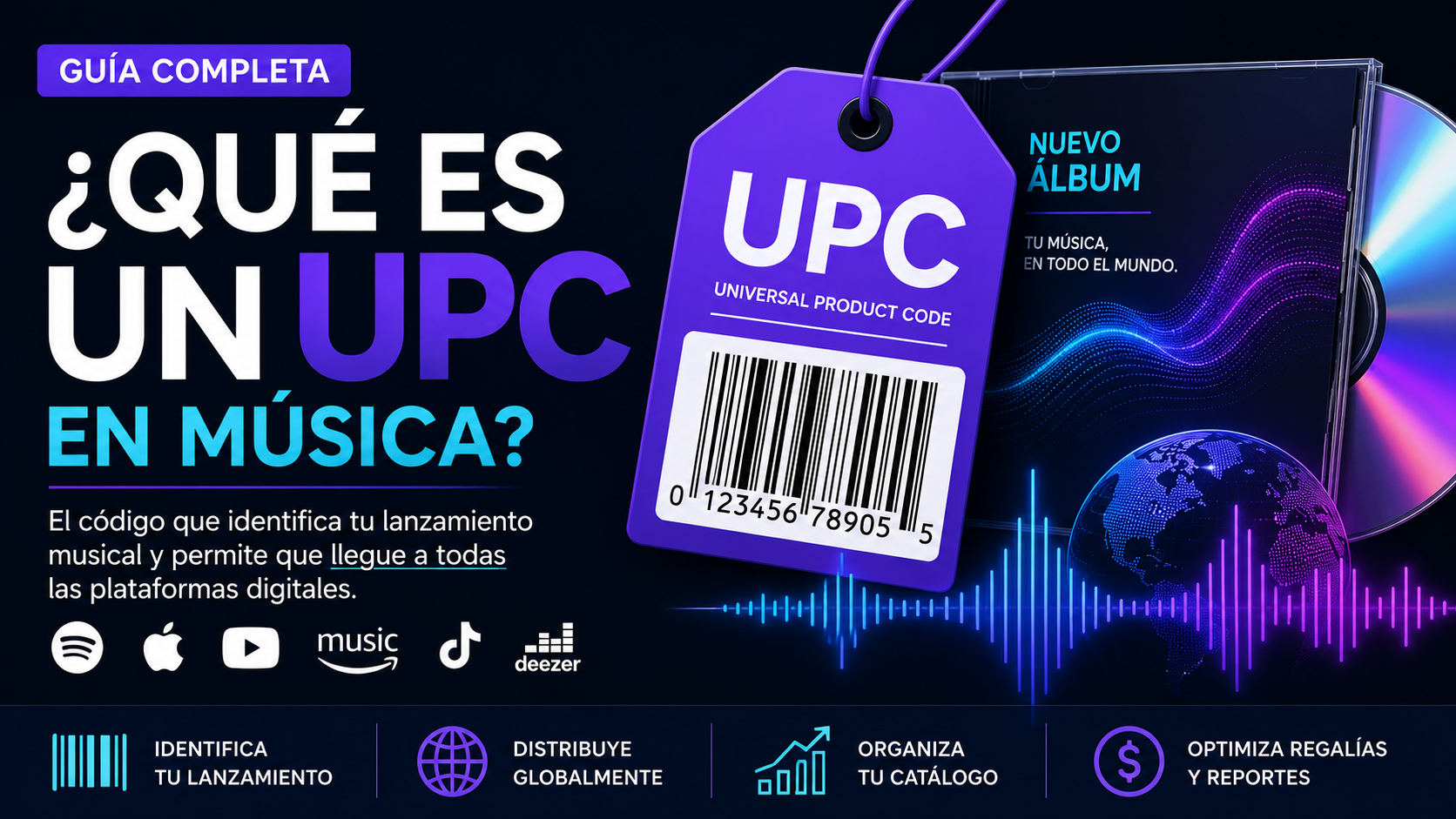
The UPC (Universal Product Code) is used by distributors, digital stores, and streaming services to recognize an album, EP, or single and correctly associate it with its metadata.
Understanding how it works helps artists, record labels, and managers organize their catalogs more effectively and avoid mistakes in their releases.
Table of Contents
- What is a UPC?
- How does it work?
- What is it used for?
- Structure of a UPC
- UPC vs ISRC
- Why is it important?
- Advantages and disadvantages
- How to obtain a UPC
- Real-world examples
- Common mistakes
- Frequently Asked Questions
- Final summary
What Is a UPC?
The UPC (Universal Product Code) is a numerical code used to uniquely identify a product.
In the music industry, a UPC identifies a:
- Album.
- EP.
- Single.
- Compilation.
- Digital release.
It does not identify individual songs.
Each release has its own UPC.
UPC: A unique code used to identify a complete music release, such as an album, EP, or single, across digital stores and streaming platforms.
How Does a UPC Work?
When an artist or label distributes music, a UPC is assigned to the release.
That code is sent together with information such as:
- Artist name.
- Release title.
- Release date.
- Cover art.
- Music genre.
- Tracklist.
Platforms use the UPC to:
- Identify the release.
- Organize catalogs.
- Associate metadata.
- Facilitate reports and sales.
What Is a UPC Used For?
1. Identifying a Release
The UPC acts as the digital fingerprint of an album, EP, or single.
Two releases may have similar names, but they will have different UPCs.
2. Organizing Catalogs
Distributors use UPCs to manage thousands or millions of releases.
This facilitates:
- Searches.
- Reports.
- Updates.
- Royalty management.
3. Distributing Music
The UPC allows Spotify, Apple Music, YouTube Music, and other platforms to recognize a release correctly.
4. Maintaining Metadata Consistency
The code helps associate:
- Cover art.
- Artist.
- Songs.
- Release date.
- Editorial information.
Structure of a UPC
A UPC generally consists of 12 digits.
Example:
012345678905
Although users rarely need to memorize it, this number is used internally to identify releases within distribution and digital commerce systems.
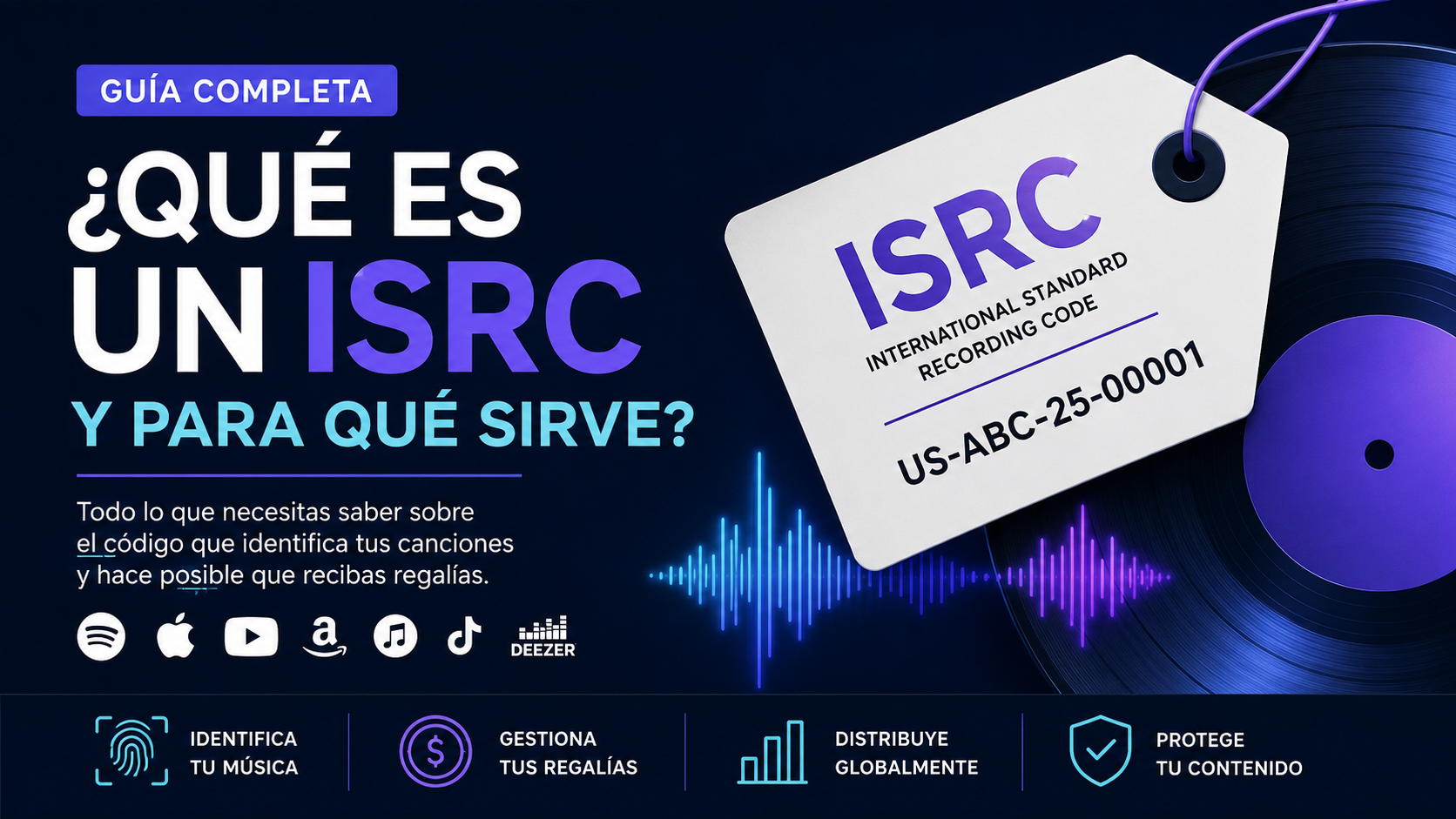
UPC vs ISRC
These two codes are often confused.
However, they serve different purposes.
| Feature | UPC | ISRC |
|---|---|---|
| Identifies | Complete release | Individual recording |
| Example | Album or EP | Song |
| Quantity | One per release | One per song |
| Main Use | Distribution and cataloging | Tracking and royalties |
Practical Example
Album:
"Summer Vibes"
Contains:
- 1 UPC for the entire album.
- 10 ISRCs, one for each song.
Summer Vibes

UPC
└── Entire Album

ISRC 1 → Song 1
ISRC 2 → Song 2
ISRC 3 → Song 3
...
ISRC 10 → Song 10
Why Is a UPC Important?
The UPC is an international standard.
It allows a release to be recognized by:
- Spotify.
- Apple Music.
- YouTube Music.
- Amazon Music.
- Deezer.
- TikTok.
- Digital stores and distributors.
Without this identification, managing millions of music releases would be far more difficult.
Advantages and Disadvantages of UPC
| Advantages | Disadvantages |
|---|---|
| Global identification | Does not identify individual songs |
| Facilitates distribution | Does not provide copyright protection |
| Organizes catalogs | Changing it may affect release continuity |
| Compatible with all platforms | Requires proper management |
How to Obtain a UPC
There are several options.
Option 1
Obtain it through a music distributor.
Many distributors automatically assign a UPC during the publishing process.
Option 2
Request codes directly from authorized organizations.
This option is commonly used by:
- Record labels.
- Companies with large catalogs.
- Distributors.
Step-by-Step: How a UPC Is Used
| Step | Action |
|---|---|
| 1 | Create the release |
| 2 | Assign a UPC |
| 3 | Add metadata |
| 4 | Distribute to platforms |
| 5 | Stores register the release |
| 6 | Reports are generated |
| 7 | Royalties and analytics are managed |
Real-World Examples
Case 1: Independent Artist
An artist releases a single.
The release receives:
- 1 UPC for the single.
- 1 ISRC for the song.
This ensures the content is properly identified across platforms.
Case 2: EP with 5 Songs
An EP has:
- 1 UPC.
- 5 ISRCs.
The UPC identifies the complete project.
The ISRCs identify each song.
Case 3: Record Label
A label releases hundreds of albums each year.
UPCs allow them to:
- Organize catalogs.
- Generate reports.
- Manage metadata.
- Facilitate global distribution.
Common Mistakes
1. Confusing UPC with ISRC
The UPC identifies a release.
The ISRC identifies a recording.
They are not interchangeable.
2. Thinking That UPC Protects Copyright
No.
The UPC is only used to identify a music product.
Copyright protection is managed through specific laws and registration systems.
3. Changing the UPC Unnecessarily
Modifying a UPC may:
- Create duplicates.
- Fragment analytics.
- Generate inconsistencies across platforms.
Frequently Asked Questions (FAQ)
What Does UPC Mean?
Universal Product Code.
It is a code used to identify products, including music releases.
What Does a UPC Identify in Music?
It identifies an entire album, EP, or single.
Does the UPC Identify Songs?
No.
Songs are identified using ISRC codes.
Can an Album Have Multiple UPCs?
Generally, no.
Each release typically has a unique UPC.
Does a Single Need a UPC?
Yes.
Even a digital single usually has its own UPC.
Does UPC Protect Copyright?
No.
It only identifies a release.
Does Spotify Use UPC?
Yes.
Spotify receives the UPC from the music distributor.
Does Apple Music Use UPC?
Yes.
Apple Music uses UPCs to organize and recognize releases.
Who Assigns a UPC?
It can be assigned by music distributors or authorized organizations.
Can I Keep the Same UPC If I Change Distributors?
In some cases, yes.
It depends on the migration process and the distributor's policies.
Final Summary
The UPC is the international standard used to identify a complete music release, such as an album, EP, or single.
Its main purpose is to facilitate:
- Digital distribution.
- Catalog organization.
- Metadata management.
- Integration with music platforms.
- Release tracking.
The UPC does not replace the ISRC or provide copyright protection, but it is a fundamental component of the modern music ecosystem.
For independent artists and record labels, understanding how UPC works helps them manage releases more efficiently and maintain a well-organized catalog.
Music distribution platforms such as UXEM Entertainment Group, among other companies in the industry, integrate UPC and ISRC management into their publishing workflows, enabling more efficient management of music releases on a global scale.