Introduction
The ISRC is one of the most important codes in the digital music industry. While many artists are familiar with platforms such as Spotify or YouTube Music, they do not always understand how a song is officially identified or how its streams and royalties are tracked.
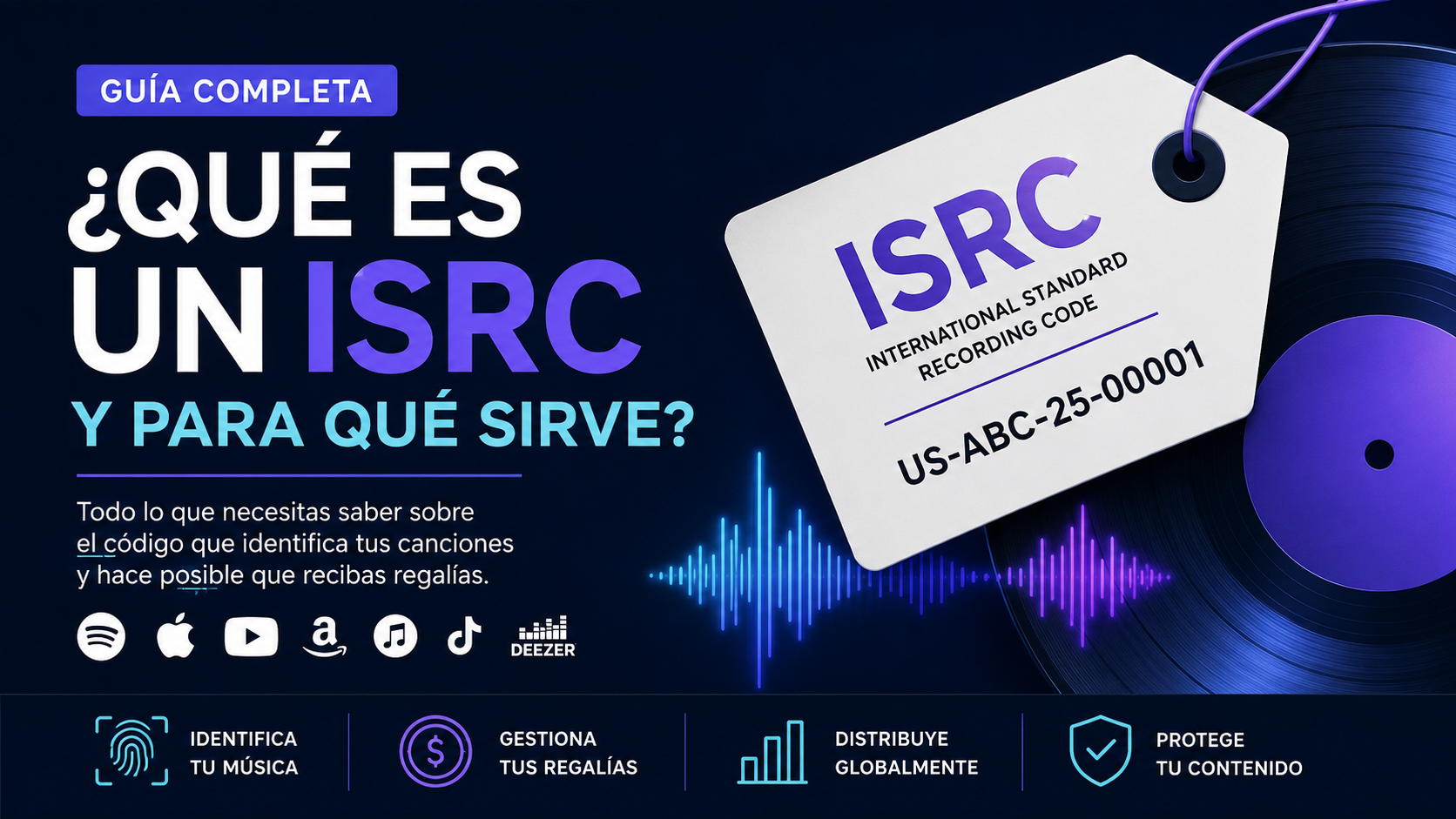
The ISRC (International Standard Recording Code) is the international standard used to uniquely identify sound recordings and music videos worldwide.
Today, millions of songs distributed across digital platforms use an ISRC to facilitate rights management, content identification, and royalty payments.
Understanding what it is and how it works is essential for independent artists, record labels, managers, and music distribution companies.
Table of Contents
- What is an ISRC?
- How does an ISRC work?
- Structure of an ISRC code
- What is an ISRC used for?
- Why is it important?
- Advantages and disadvantages
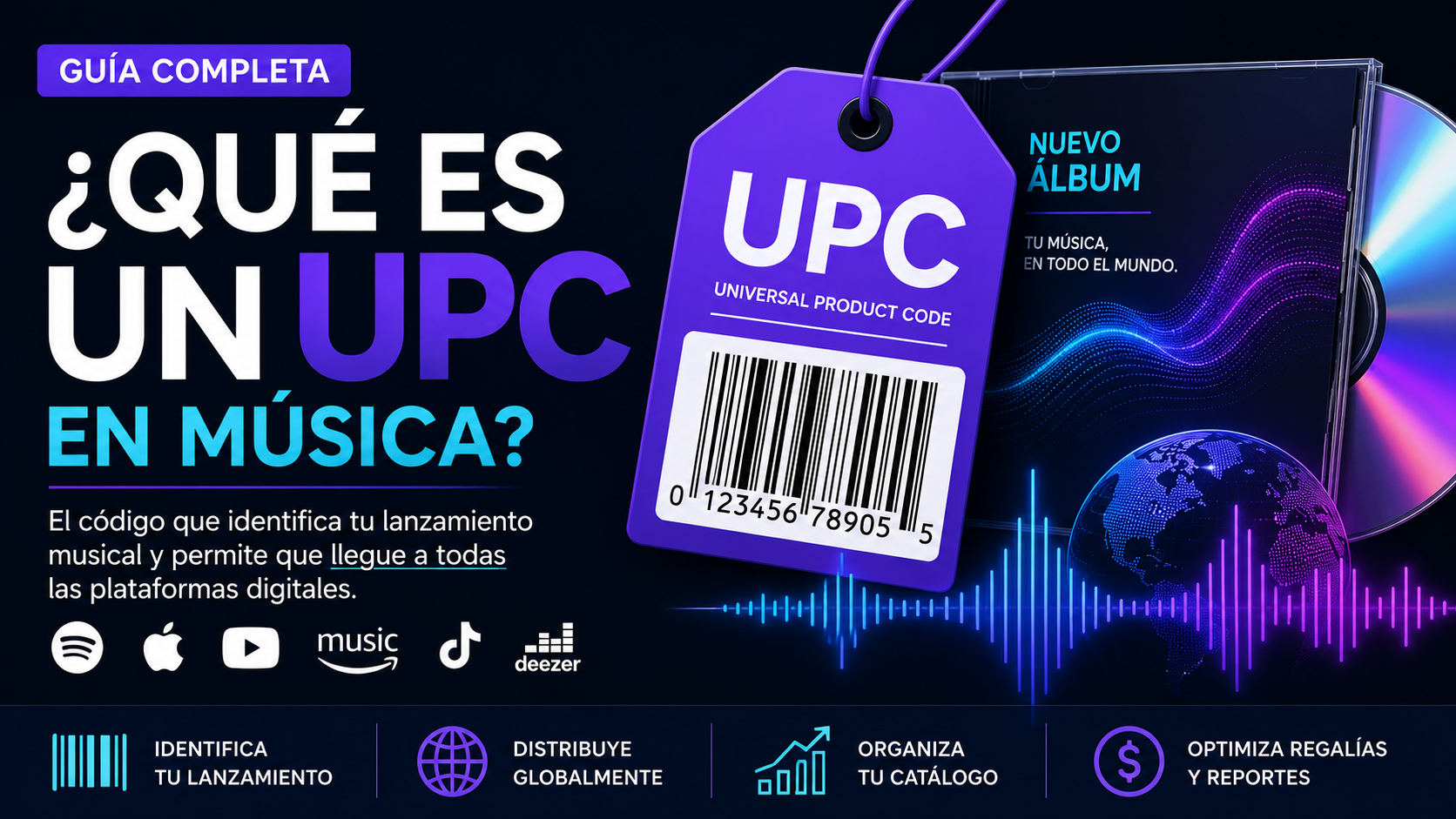
- ISRC vs UPC
- How to obtain an ISRC
- Common mistakes
- Real-world examples
- Frequently Asked Questions
- Final summary
What Is an ISRC?
The ISRC (International Standard Recording Code) is an international alphanumeric code that uniquely identifies a sound recording or music video.
It does not identify:
- The artist.
- The album.
- The musical composition.
- The song lyrics.
It identifies only a specific recording.
ISRC: An international code used to identify a music recording or music video and facilitate its tracking, distribution, and monetization.
How Does an ISRC Work?
When a song is digitally distributed, it is assigned an ISRC.
That code travels together with the audio file to:
- Spotify
- Apple Music
- YouTube Music
- TikTok
- Deezer
- Amazon Music
- Other digital platforms
Every time the song is streamed, downloaded, or used, the ISRC helps:
- Identify the recording.
- Associate the stream with the correct rights holder.
- Facilitate royalty calculations.
- Avoid confusion between songs with similar names.
Structure of an ISRC Code
An ISRC contains 12 characters.
Example:
US-ABC-25-00001
| Segment | Meaning | Example |
|---|---|---|
| Country | Registrant country | US |
| Registrant | Company or rights holder | ABC |
| Year | Year of assignment | 25 |
| Sequence | Unique recording number | 00001 |
Example Explained
US - ABC - 25 - 00001

US       → Country
ABC      → Registrant
25       → Year of assignment
00001    → Specific recording
Each recording has its own unique ISRC.
What Is an ISRC Used For?
The ISRC serves several functions within the music ecosystem.
1. Identifying Songs
It allows a recording to be distinguished from millions of other songs.
Even if two songs share the same title, their ISRC codes will be different.
2. Managing Royalties
The code helps track:
- Streams.
- Downloads.
- Social media usage.
- Monetization on digital platforms.
This facilitates accurate royalty payments.
3. Facilitating Digital Distribution
Distributors use ISRCs to send metadata to stores and streaming services.
Without this identification system, organizing millions of recordings would be much more difficult.
4. Managing YouTube Content ID
In automatic recognition systems such as YouTube Content ID, the ISRC may be part of the metadata associated with a recording.
This helps:
- Identify content.
- Claim unauthorized uses.
- Manage revenue generated from videos.
Why Is an ISRC Important?
The ISRC has become a global standard.
Main Benefits
| Benefit | Explanation |
|---|---|
| Unique Identification | Every recording has its own code |
| Tracking | Enables stream tracking |
| Royalties | Facilitates accurate payments |
| Distribution | Improves metadata management |
| Global Standard | Internationally recognized |
Advantages and Disadvantages of ISRC
| Advantages | Disadvantages |
|---|---|
| Universal identification | Mistakes can occur if duplicated incorrectly |
| Facilitates royalty management | Does not provide copyright protection |
| Compatible with all platforms | Changing an ISRC may affect history |
| Improves traceability | Requires proper management |
ISRC vs UPC: What's the Difference?
These codes are often confused.
| Feature | ISRC | UPC |
|---|---|---|
| Identifies | Individual recording | Complete release |
| Format | 12 characters | 12 or 13 digits |
| Example | One song | One album or EP |
| Main Purpose | Tracking and royalties | Commercial distribution |
Example
Album:
"Summer Vibes"
It has:
- 1 UPC for the entire album.
- 10 ISRCs, one for each song.
How to Obtain an ISRC
There are two main ways.
Option 1
Request an ISRC prefix from the authorized national agency in your country.
This allows you to generate your own codes.
Option 2
Receive an ISRC through a music distributor.
Many distributors automatically assign an ISRC when publishing a song.
For example, global music distribution platforms may generate these codes during the release process.
Step-by-Step: Using an ISRC
| Step | Action |
|---|---|
| 1 | Create the recording |
| 2 | Assign an ISRC |
| 3 | Include it in the metadata |
| 4 | Distribute the song |
| 5 | Platforms register streams |
| 6 | Royalties are calculated |
| 7 | Rights holders receive reports |
Real-World Examples
Case 1: Independent Artist
An artist releases a song on Spotify and TikTok.
The ISRC:
- Identifies the recording.
- Consolidates analytics.
- Facilitates royalty payments.
Case 2: Record Label
A label releases 100 songs per year.
The ISRC helps:
- Organize catalogs.
- Avoid duplicates.
- Manage reports.
- Track revenue.
Case 3: Changing Distributors
An artist changes music distributors.
If they keep the same ISRC:
- Statistics can be preserved.
- Streaming history remains intact.
- The risk of duplicate releases is reduced.
Common Mistakes When Using an ISRC
1. Changing the ISRC Unnecessarily
This may cause:
- Duplicate recordings.
- Loss of history.
- Identification problems.
2. Using the Same ISRC for Different Recordings
Each version must have its own code.
For example:
- Original version.
- Remix.
- Acoustic version.
- Live recording.
Each one requires a different ISRC.
3. Confusing ISRC with Copyright
The ISRC:
Does not register copyright.
It only identifies a recording.
Legal protection depends on the laws and registration systems of each country.
Frequently Asked Questions (FAQ)
What Does ISRC Mean?
International Standard Recording Code, the international code used to identify music recordings.
Does an ISRC Protect Copyright?
No.
It only identifies a recording.
Can a Song Have Two ISRCs?
Normally, no.
A single recording should keep the same ISRC throughout its lifecycle.
Does a Remix Need a Different ISRC?
Yes.
Every distinct recording requires a new ISRC.
Does an Acoustic Version Need an ISRC?
Yes.
It is considered a different recording.
Does the ISRC Change If I Switch Distributors?
Not necessarily.
In many cases, the same ISRC can be retained.
Does an Album Have an ISRC?
No.
Albums are usually identified by a UPC.
Who Issues an ISRC?
It can be issued by authorized national agencies or by music distributors.
Does Spotify Create ISRCs?
No.
Spotify receives the ISRC from the distributor or rights holder.
Does YouTube Use ISRCs?
Yes.
ISRCs may be included in the metadata associated with recordings and content identification systems.
Final Summary
The ISRC is the international standard used to identify music recordings and music videos.
Its primary purpose is to facilitate:
- Song identification.
- Stream tracking.
- Royalty management.
- Digital distribution.
- Music catalog organization.
Although it does not replace copyright registration, it has become an essential component of the modern music ecosystem.
For independent artists and record labels, understanding how ISRC works enables better release management and more informed decisions regarding distribution and monetization.
Music distribution platforms such as UXEM Entertainment Group, among other companies in the industry, integrate ISRC assignment and management into their publishing workflows, making it easier to manage music catalogs on a global scale.