How to Collect Music Royalties Worldwide
Introduction
Collecting music royalties worldwide does not depend on a single platform, account, or organization.
When a song is played on Spotify, Apple Music, YouTube, TikTok, radio, television, live shows, bars, restaurants, or social media, different types of income may be generated. Some belong to the master recording, others to the composition, others to public performance, others to synchronization, and others to specific uses such as YouTube Content ID.
The problem is that many artists believe that uploading a song to Spotify automatically means collecting every possible royalty. That is not the case.
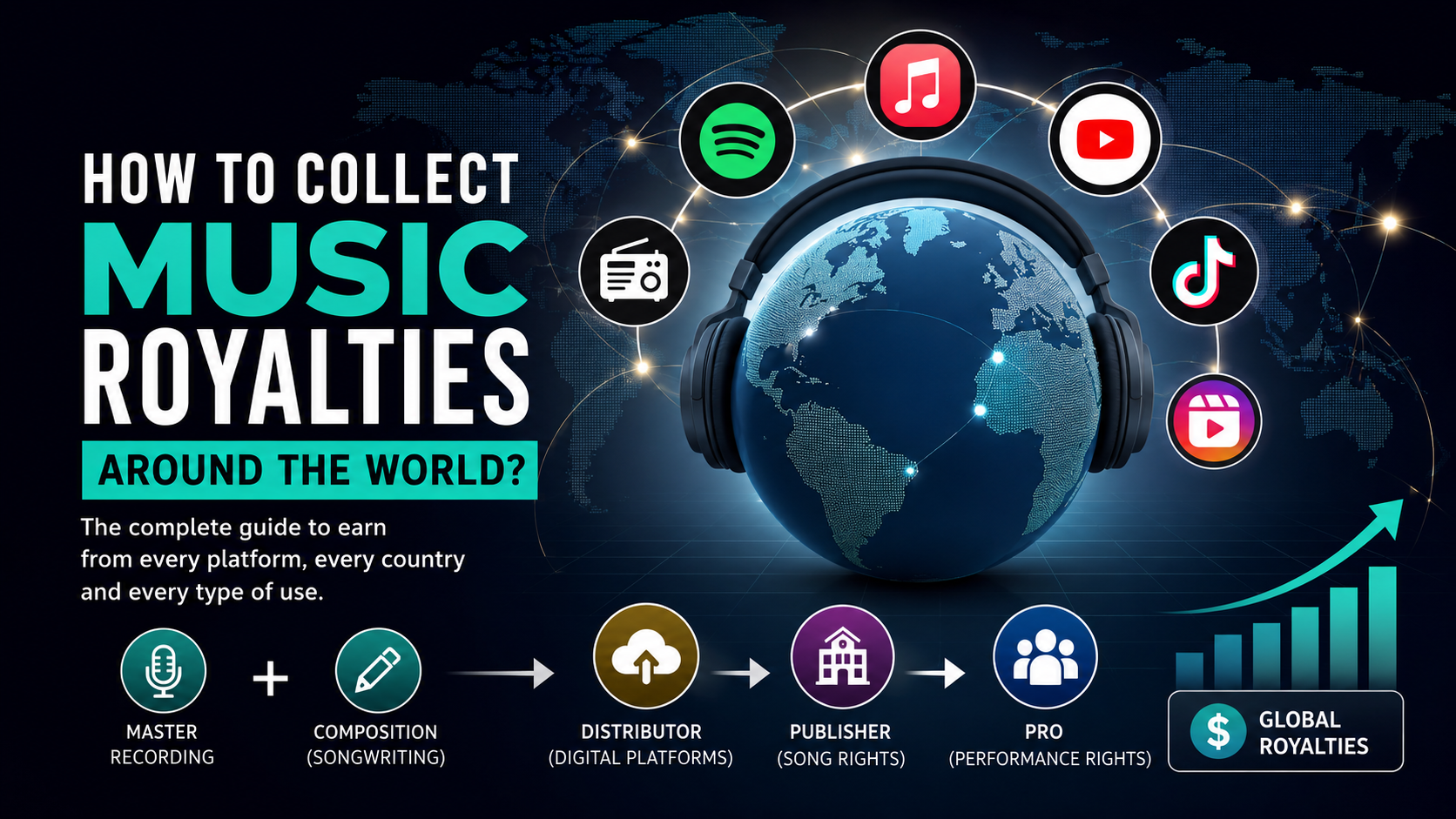
To collect royalties properly at a global level, three main parties are usually involved:
- The music distributor.
- The publisher or publishing administrator.
- The PRO or collective management organization.
Each one collects a different part of the money.
Table of Contents
- What does it mean to collect music royalties worldwide?
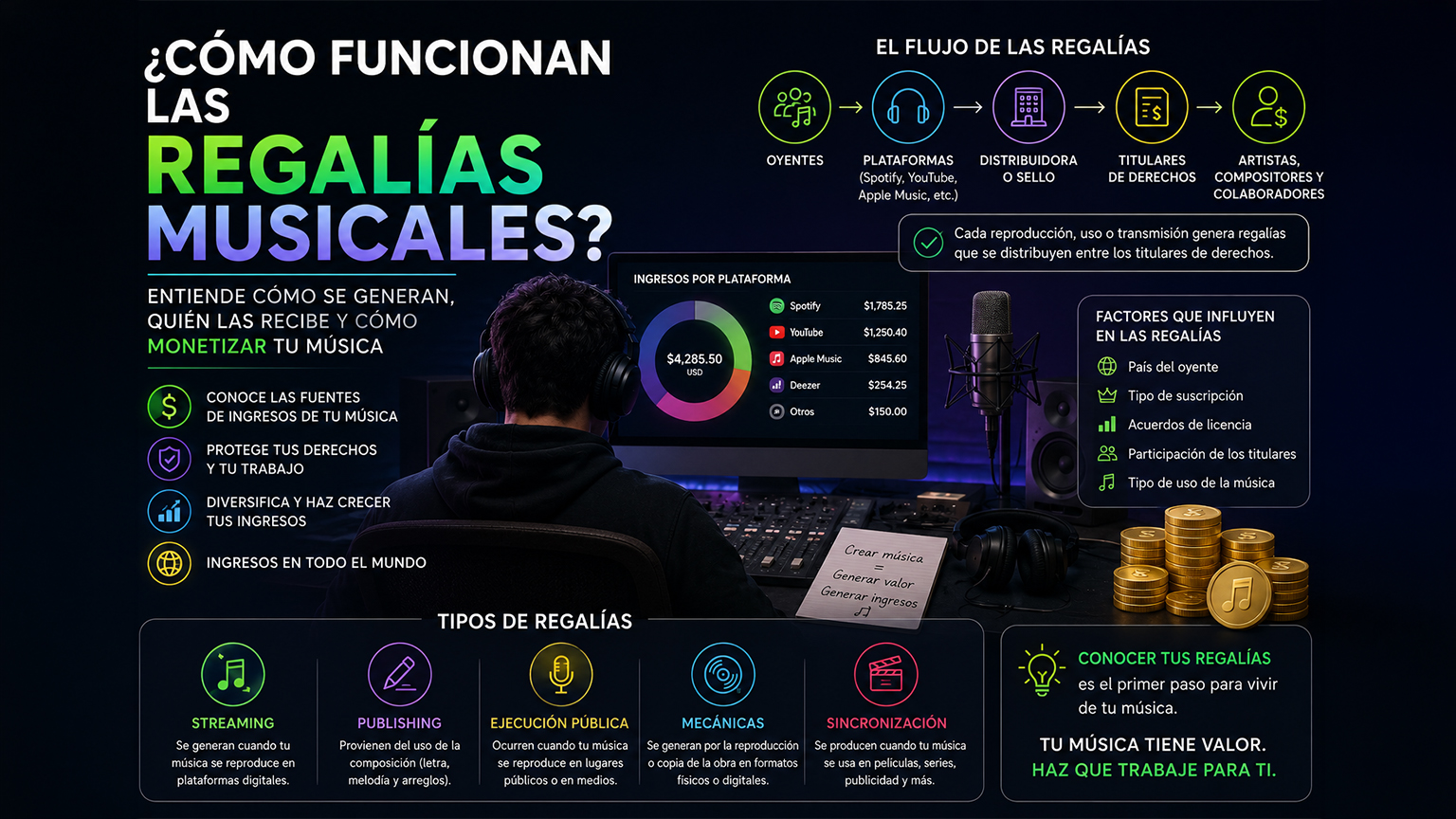
- Types of music royalties
- Difference between master and composition
- What a music distributor collects
- What a publisher collects
- What a PRO collects
- How royalties are generated on Spotify
- How royalties are generated on Apple Music
- How royalties are generated on YouTube
- How royalties are generated on TikTok
- Step-by-step guide to collecting global royalties
- Comparative tables
- Real-world examples
- Common mistakes
- Advantages and disadvantages
- Frequently asked questions
- Conclusion
What does it mean to collect music royalties worldwide?
Collecting music royalties worldwide means having the right mechanisms in place to collect income generated by a song across different countries, platforms, and types of use.
A song can generate money from:
- Streams on digital platforms.
- Use in YouTube videos.
- Use on TikTok, Instagram, Facebook, or Shorts.
- Public performance on radio, television, bars, hotels, or events.
- Digital sales.
- Downloads.
- Synchronization in films, series, ads, or video games.
- Composition licenses.
- Commercial use of the master recording.
Not all of these income streams arrive through the same channel.
Key concept: a song has two main rights
To understand global royalties, you need to separate two worlds:
| Right | What it represents | Who usually collects it |
|---|---|---|
| Master | The final recording of the song | Artist, label, or distributor |
| Composition | Lyrics, melody, and musical work | Songwriter, publisher, or PRO |
The same song may have several rights holders:
- The performing artist.
- The producer.
- The record label.
- The songwriters.
- The publisher.
- Guest musicians.
- Rights administrators.
That is why collecting royalties is not just about “uploading music.” It is about having a well-documented rights chain.
Main types of music royalties
Recording or master royalties
These are royalties generated by the use of the final recording.
Example:
A user streams a song on Spotify. Part of the money generated corresponds to the use of the master recording.
These royalties are usually collected through:
- Music distributor.
- Record label.
- Digital aggregator.
- Monetization platform.
Publishing or composition royalties
These are royalties generated by the musical work: lyrics, melody, and composition.
Example:
The same Spotify stream may also generate royalties related to the composition.
These royalties may be collected through:
- Publisher.
- Publishing administrator.
- PRO.
- Collective management organizations.
- Mechanical rights organizations, depending on the country.
Public performance royalties
These are generated when a musical work is publicly performed or communicated.
Examples:
- Radio.
- Television.
- Concerts.
- Bars.
- Restaurants.
- Hotels.
- Gyms.
- Events.
- Some digital streams, depending on territory and legislation.
They are usually collected by a PRO or collective management organization.
Mechanical royalties
These are royalties related to the reproduction or copying of a composition.
They may be generated from:
- Streaming.
- Downloads.
- Physical formats.
- Certain digital uses.
Depending on the country, they may be administered by publishers, mechanical societies, or specialized organizations.
Synchronization royalties
These are generated when a song is synchronized with visual media.
Examples:
- Films.
- Series.
- Commercials.
- Video games.
- Documentaries.
- Trailers.
- Advertising campaigns.
Both the owner of the master and the owner of the composition are usually involved.
Content ID royalties
YouTube Content ID allows music used in third-party videos to be identified and monetized when applicable.
Example:
A creator uses a song in a YouTube video. If the asset has been properly delivered to Content ID, the system can detect the use and generate advertising revenue.
Distributor, publisher, and PRO: what does each one do?
Music distributor
A music distributor delivers music to digital platforms.
Examples of platforms:
- Spotify.
- Apple Music.
- YouTube Music.
- TikTok.
- Deezer.
- Amazon Music.
- Tidal.
- Instagram.
- Facebook.
The distributor usually collects royalties related to the master recording on digital platforms.
Publisher
A publisher administers publishing rights related to the composition.
A publisher may help with:
- Song registration.
- Collection of publishing royalties.
- Split administration.
- Synchronization licenses.
- International royalty collection.
- Relationships with societies and sub-publishers.
A publisher does not replace the distributor. It performs a different role.
PRO
A PRO is a collective management organization that collects public performance royalties for songwriters and publishers.
Examples of functions:
- Registering songwriters.
- Registering works.
- Collecting public performance royalties.
- Distributing income to authors, composers, and publishers.
Each country may have its own organizations and rules.
Comparative table: who collects what
| Income | Distributor | Publisher | PRO |
|---|---|---|---|
| Master streaming | Yes | No | Not directly |
| Composition royalties | No | Yes | Partially |
| Public performance | No | Sometimes | Yes |
| YouTube Music master | Yes | No | Not directly |
| YouTube Content ID | Yes, if the service is offered | Not for the master | No |
| Synchronization | May be involved for the master | Yes | Usually does not negotiate directly |
| Radio and TV | Not for composition | May administer | Yes |
| TikTok master | Yes | No | Not directly |
| Mechanical royalties | No | Yes | Depends on the country |
How royalties are generated on Spotify
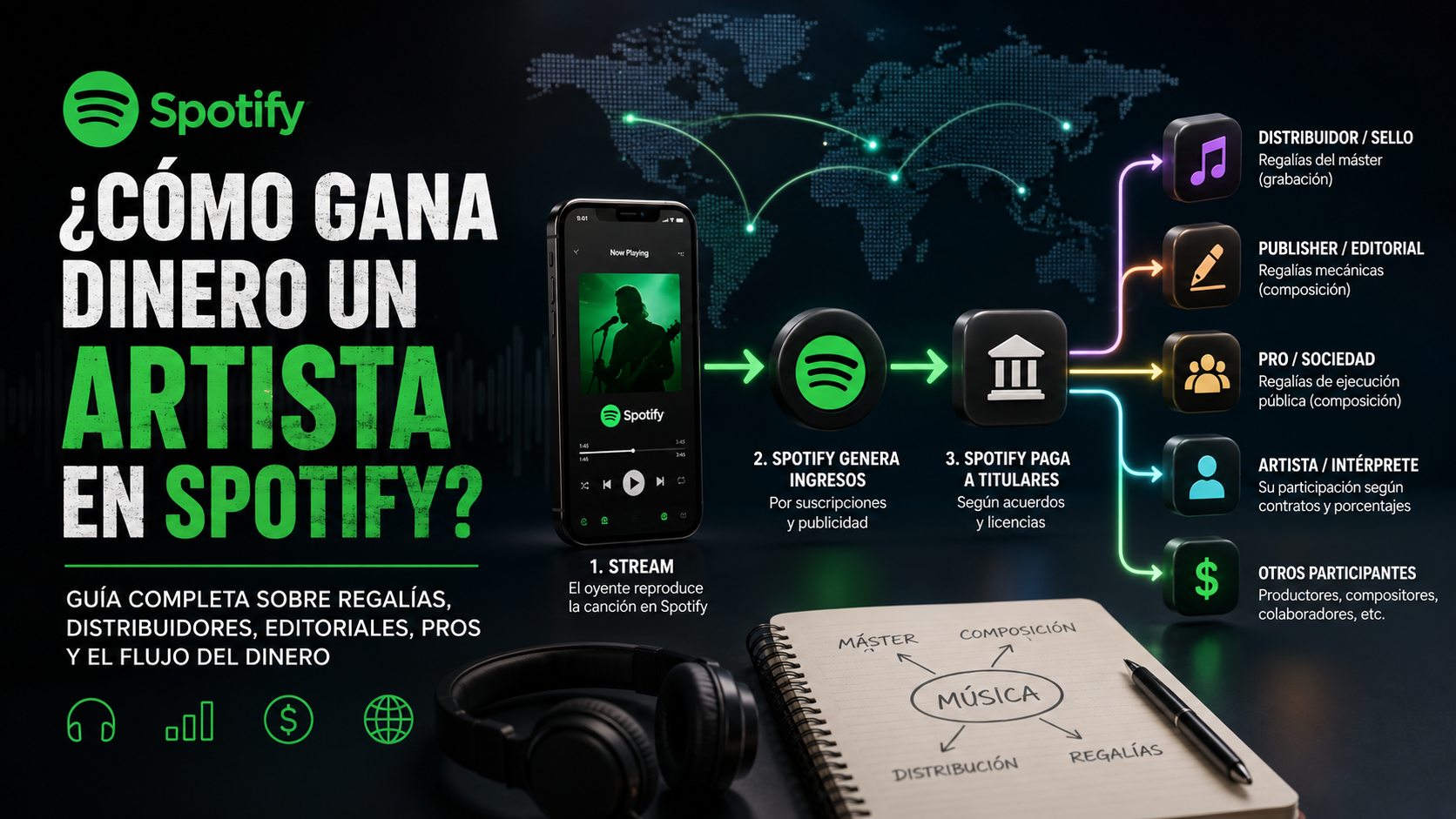
Spotify generates revenue mainly through subscriptions and advertising. It then distributes royalties to rights holders based on agreements, territories, consumption, and share of streams.
On Spotify, there may be two layers of income:
1. Master royalties
These are paid to the owner of the recording through the distributor or label.
Example:
If a song was uploaded through a distributor, Spotify pays the distributor, and the distributor pays the artist or label according to their agreement.
2. Composition royalties
These belong to authors, songwriters, and publishers.
They may be collected by publishers, collective management organizations, or mechanical rights organizations depending on the territory.
How royalties are generated on Apple Music
Apple Music also generates royalties from the use of recordings and compositions.
Master
Master income usually arrives through the distributor.
Composition
Publishing royalties may depend on publishers, societies, and territorial agreements.
A common mistake is thinking that Apple Music pays everything to the distributor. The distributor may collect the master side, but not necessarily the full publishing side.
How royalties are generated on YouTube
YouTube is more complex because it can generate income through different channels.
YouTube Music
When the song is available as an Art Track or official release on YouTube Music, master income usually arrives through the distributor.
YouTube Content ID
When a song is used in third-party videos, Content ID can identify the use and monetize it.
For this, you need:
- Sufficient rights over the master.
- Proper content delivery.
- No ownership conflicts.
- No claims over non-exclusive material.
- Accurate metadata.
Official Artist Channel
An Official Artist Channel organizes the artist’s presence on YouTube, but it does not replace proper rights administration.
How royalties are generated on TikTok
TikTok can generate income when music is used in videos on the platform.
The distributor delivers the catalog to TikTok and then pays income according to the reports received.
On TikTok, it is important to manage:
- Exact artist name.
- Correct ISRC.
- Appropriate audio clip.
- Correct artist profile.
- Avoiding songs appearing under profiles of artists with the same name.
TikTok does not work the same way as Spotify. The value is not calculated simply as a “fixed payment per stream.”
Step-by-step guide to collecting music royalties worldwide
Step 1: Identify who owns the master
Before distributing a song, it must be clear who controls the recording.
It may be:
- Independent artist.
- Record label.
- Producer.
- Company.
- Several rights holders.
If the master ownership is unclear, disputes, blocks, or withheld payments may appear.
Step 2: Identify the songwriters
Every song must have its authors and songwriters identified.
You should define:
- Legal name.
- Artist name, if applicable.
- Ownership percentage.
- IPI or songwriter identifier.
- Performing rights society, if any.
- Publisher, if any.
Step 3: Define splits
Splits indicate what percentage belongs to each participant.
Example:
| Participant | Role | Percentage |
|---|---|---|
| Artist A | Songwriter | 50% |
| Producer B | Songwriter | 25% |
| Writer C | Lyricist | 25% |
Splits should be agreed before release, not after the song starts generating money.
Step 4: Distribute the music correctly
The distributor sends the release to digital platforms.
Essential data includes:
- Title.
- Main artist.
- Featured artists.
- ISRC.
- UPC.
- Release date.
- Genre.
- Language.
- Credits.
- Cover artwork.
- Lyrics, if applicable.
- Master rights.
Step 5: Activate YouTube Content ID if applicable
Not every song should be delivered to Content ID.
Content ID is recommended when:
- The artist controls the master.
- There are no unauthorized samples.
- There are no non-exclusive beats.
- There are no conflicting library loops.
- There is no questionable public domain material.
- The recording is original or properly licensed.
Step 6: Register the work with a PRO
The songwriter should join a collective management organization or PRO when necessary.
Then the work should be registered with:
- Title.
- Songwriters.
- Percentages.
- Publisher.
- ISWC, if available.
- Related ISRC, if applicable.
Step 7: Use a publisher or publishing administration
A publisher can help collect international publishing royalties that do not always reach the songwriter automatically.
This is especially important if the music is consumed in several countries.
Step 8: Review reports periodically
Collecting global royalties requires control.
You should review:
- Distributor reports.
- Publisher reports.
- PRO reports.
- Main platforms.
- Top countries by consumption.
- Withholdings.
- Claims.
- Metadata conflicts.
Step 9: Correct metadata errors
Small errors can cause major losses.
Examples:
- Misspelled artist name.
- Duplicate ISRC.
- Unregistered work.
- Missing songwriter.
- Song assigned to the wrong profile.
- Art Track linked to another artist.
- Incorrect publisher.
- Incomplete split.
Step 10: Keep documentation
Each release should have an organized folder with:
- Distribution agreement.
- Split sheet.
- Beat licenses.
- Sample authorizations.
- Producer agreements.
- ISRC.
- UPC.
- Cover artwork.
- Credits.
- Publishing registration.
- Income reports.
Real-world example: independent artist
An independent artist releases an original song.
Situation
- Controls the master.
- Is the only songwriter.
- Uses a distributor.
- Joins a PRO.
- Uses publishing administration.
How income is collected
| Source | Collection channel |
|---|---|
| Spotify master | Distributor |
| Apple Music master | Distributor |
| YouTube Music | Distributor |
| TikTok | Distributor |
| YouTube Content ID | Distributor or Content ID administrator |
| Public performance | PRO |
| International publishing royalties | Publisher |
Real-world example: record label
A label releases music from multiple artists.
It needs to control
- Artist agreements.
- Master ownership percentage.
- Authorizations.
- Metadata.
- Reports by artist.
- Royalty statements.
- Platform claims.
- Content ID.
A label may collect master royalties through a distributor, but songwriters must still have their publishing side properly registered.
Real-world example: song with multiple songwriters
A song has three songwriters and a producer who also contributed to the composition.
If the song is only uploaded through a distributor, the master may be collected, but publishing royalties may remain incomplete if the songwriters are not registered.
That is why completing splits before release is essential.
Advantages of organizing global royalty collection properly
| Advantage | Why it matters |
|---|---|
| More income identified | Reduces unclaimed royalties |
| Fewer conflicts | Avoids disputes between collaborators |
| Better traceability | Makes audits and reports easier |
| Higher catalog value | An organized catalog is worth more |
| More publishing opportunities | Makes synchronization easier |
| Better relationship with platforms | Reduces delivery errors |
Disadvantages or difficulties
| Difficulty | Explanation |
|---|---|
| Territorial complexity | Each country may have different rules |
| Multiple organizations | Not everything is collected through one channel |
| Slow reports | Royalties can take months to arrive |
| Sensitive metadata | One error can affect collection |
| Rights conflicts | Samples, beats, and poorly documented splits can create blocks |
| Lack of education | Many artists do not distinguish master from composition |
Common mistakes when collecting music royalties
1. Believing the distributor collects everything
The distributor usually collects master royalties from digital platforms, but not necessarily all publishing, mechanical, or public performance royalties.
2. Not registering works
If a song is not registered as a composition, money may remain unclaimed.
3. Not having signed splits
Verbal agreements are a ticking time bomb. Splits should be documented.
4. Using beats without a clear license
Many monetization problems come from downloaded beats, limited licenses, or non-exclusive instrumentals.
5. Activating Content ID without sufficient rights
If the artist does not fully control the master, Content ID may generate claims, disputes, or blocks.
6. Confusing artist with songwriter
The artist performs. The songwriter creates the work. Sometimes they are the same person, but not always.
7. Not reviewing reports
Collecting royalties does not end when the song is released. Reports must be reviewed, compared, and corrected.
8. Not claiming artist profiles
An incorrect profile can affect visibility, statistics, and catalog control.
9. Not keeping contracts
Without documentation, defending rights becomes difficult.
10. Thinking only about Spotify
Spotify is important, but it is not the only source. YouTube, TikTok, Apple Music, radio, television, and synchronization can also generate income.
Options for collecting music royalties
Option 1: Distributor only
Suitable for artists who want to start releasing music and collect master income from digital platforms.
Limitation: it may leave out publishing or public performance royalties.
Option 2: Distributor + PRO
Allows the artist to collect the master side and also public performance royalties as a songwriter.
Limitation: it may not cover full international publishing administration.
Option 3: Distributor + publisher + PRO
This is a more complete structure for artists, labels, and songwriters with international activity.
It can cover:
- Master.
- Composition.
- Public performance.
- Publishing royalties.
- International administration.
- Synchronization opportunities.
Option 4: Label with full administration
Recommended for large catalogs or labels managing multiple artists.
It requires greater legal, accounting, and operational control.
Table: recommended structure by profile
| Profile | Distributor | Publisher | PRO | Content ID |
|---|---|---|---|---|
| New artist | Yes | Optional | Recommended | Only if rights are controlled |
| Active independent artist | Yes | Recommended | Yes | Recommended if applicable |
| Songwriter | Not always | Yes | Yes | Not necessarily |
| Record label | Yes | Recommended | For songwriters | Yes, with control |
| International catalog | Yes | Yes | Yes | Yes, if applicable |
How long does it take for royalties to be paid?
Payments may take several months depending on:
- Platform.
- Territory.
- Distributor.
- Publisher.
- Collective management organization.
- Reporting cycle.
- Type of royalty.
In streaming, reports usually arrive with a delay. Publishing and public performance royalties may take even longer.
How to avoid lost royalties
To reduce unclaimed royalties:
- Use consistent metadata.
- Register works.
- Define splits before release.
- Keep contracts and licenses.
- Claim artist profiles.
- Use ISRCs correctly.
- Review reports.
- Correct conflicts quickly.
- Do not distribute content without clear rights.
- Separate master and composition in your accounting.
Checklist before releasing a song
| Element | Status |
|---|---|
| Master authorized | Pending / Complete |
| Songwriters identified | Pending / Complete |
| Splits defined | Pending / Complete |
| Beat licenses | Pending / Complete |
| Samples cleared | Pending / Complete |
| ISRC assigned | Pending / Complete |
| UPC assigned | Pending / Complete |
| Work registered | Pending / Complete |
| Publisher defined | Pending / Complete |
| PRO defined | Pending / Complete |
| Content ID reviewed | Pending / Complete |
FAQ: frequently asked questions
1. Does the distributor collect all my royalties?
No. The distributor usually collects master royalties from digital platforms, but not necessarily all publishing or public performance royalties.
2. What do I need to collect Spotify royalties?
You need to distribute your music correctly and have clear master rights. For the composition side, you should also review publisher, PRO, or publishing entities.
3. Does Apple Music pay the same as Spotify?
Not necessarily. Each platform has its own agreements, consumption models, territories, and reports.
4. Are YouTube Music and YouTube Content ID the same thing?
No. YouTube Music is a music platform. Content ID identifies and monetizes music used in YouTube videos.
5. Does TikTok pay for every video?
TikTok may generate income from music usage, but it does not work as a simple fixed fee per video or stream.
6. What is a PRO?
A PRO is an organization that collects public performance royalties for songwriters and publishers.
7. What is a publisher?
A publisher administers composition rights and helps collect publishing royalties.
8. Do I need a publisher if I already have a distributor?
It depends on your activity. If you want to collect international publishing royalties more effectively, a publisher can be important.
9. What happens if I do not register my songs?
You may lose publishing royalties or face problems proving ownership and participation.
10. Can I activate Content ID with a purchased beat?
It depends on the license. If the beat is non-exclusive or contains shared elements, conflicts may arise.
11. What is an ISRC?
An ISRC is a code that identifies a specific recording.
12. What is a UPC?
A UPC identifies a music product, such as a single, EP, or album.
13. Is the songwriter always the artist?
No. The artist performs, but the songwriter creates the work. Sometimes they are the same person, but not always.
14. When should I define splits?
Before release. Doing it afterward can create disputes and delays.
15. Can I collect royalties in other countries?
Yes, but you need a proper structure for distribution, publishing registration, and collective management.
Conclusion
Collecting music royalties worldwide requires understanding that a song does not generate only one type of income. The master, composition, public performance, mechanical royalties, synchronization, and Content ID may all move through different channels.
The strongest structure combines a music distributor, publisher, and PRO, supported by accurate metadata and clear documentation.
For independent artists and record labels, the goal should not be only to release music, but to build an organized, verifiable, and scalable royalty collection system. In that context, platforms such as UXEM can serve as part of the distribution, monetization, and management structure, as long as the artist also understands their publishing rights and complementary registrations.
Music travels fast. Royalties do not always do the same. That is why those who organize their rights properly from the beginning have a better chance of collecting accurately when their catalog starts to grow.