How Does an Artist Make Money on Spotify?
Introduction
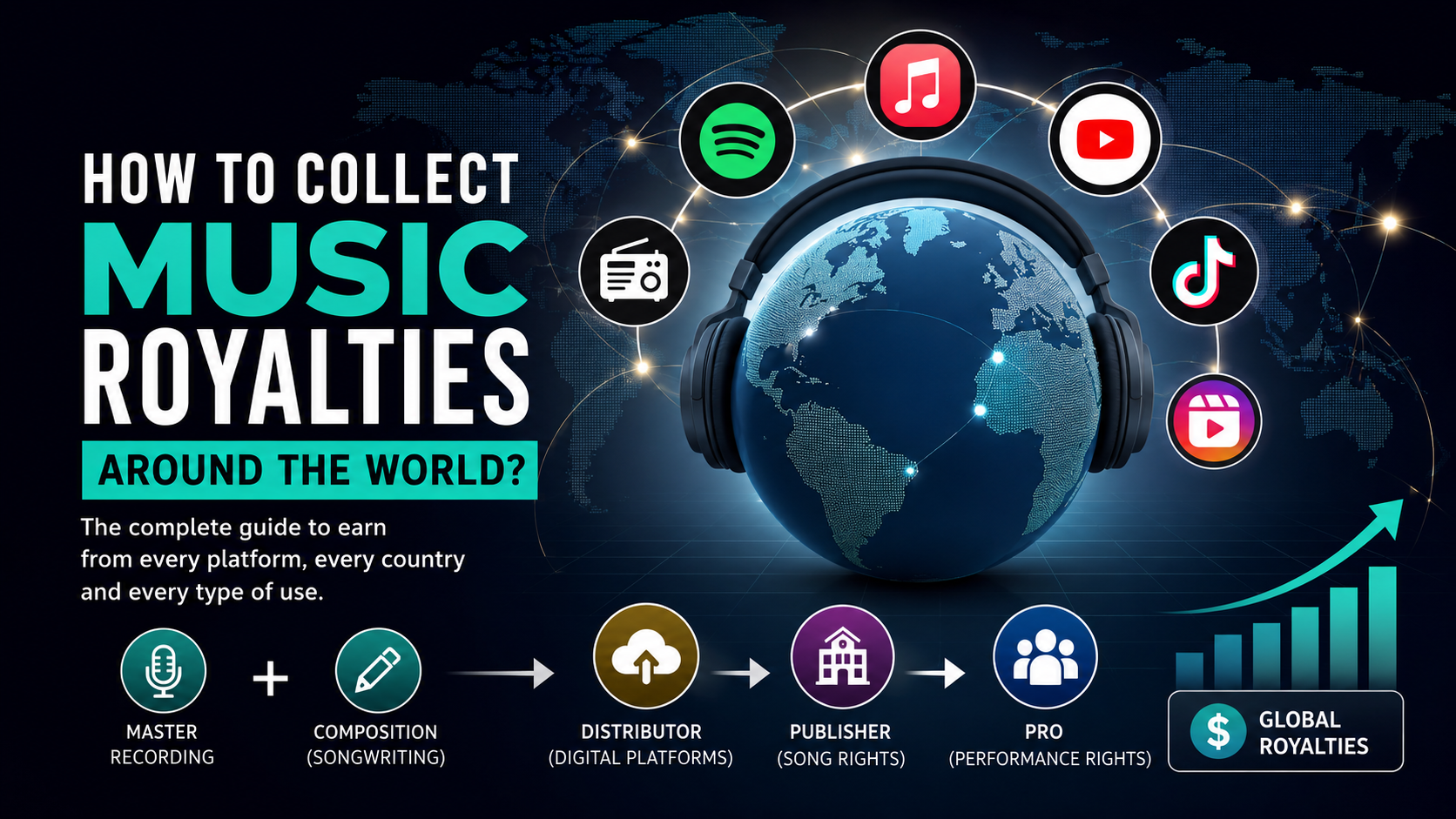
An artist can make money on Spotify every time their music is streamed, but the payment does not come from a single source and does not work as a fixed rate per stream.
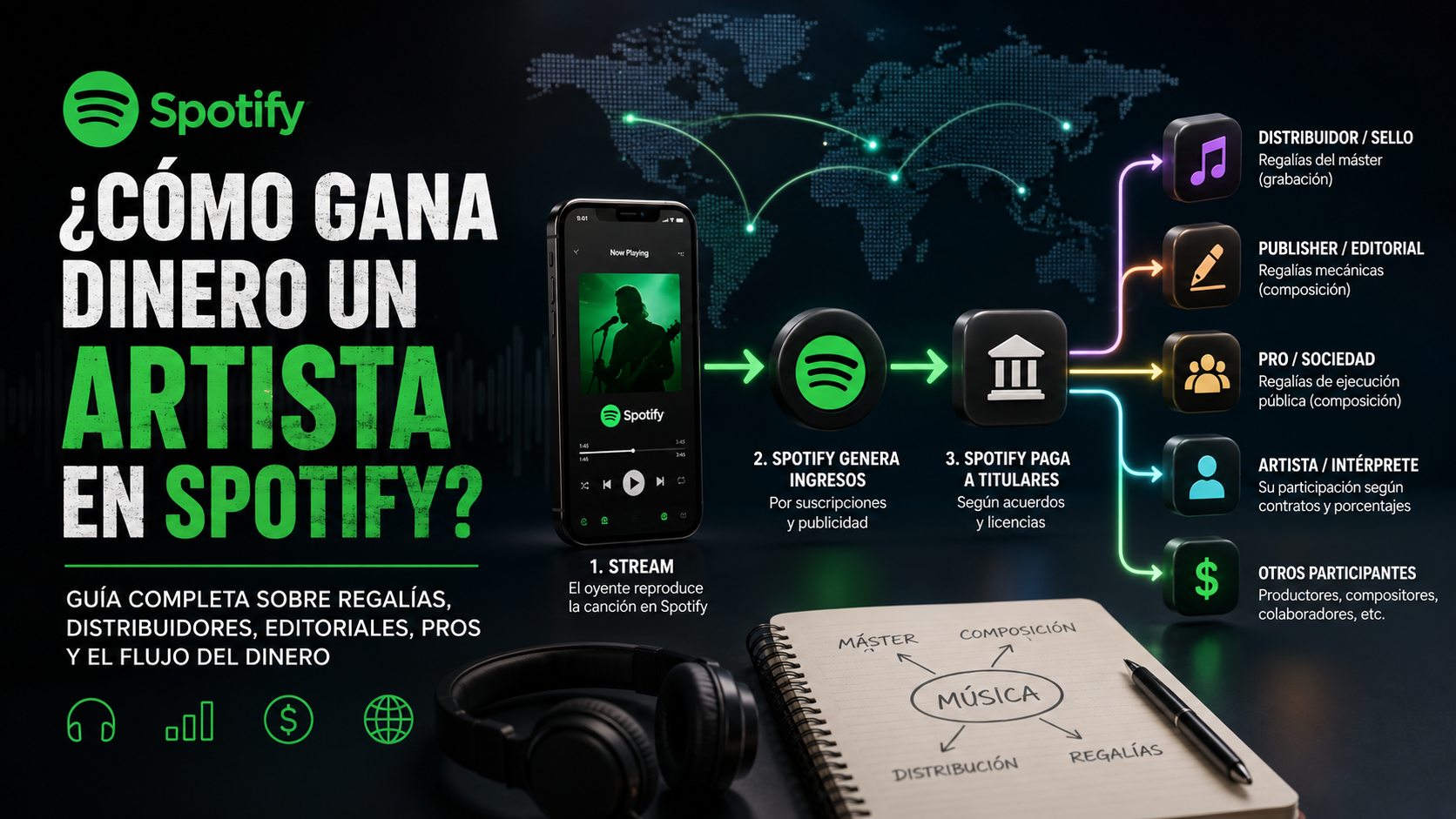
Spotify generates revenue mainly through subscriptions and advertising. It then pays royalties to rights holders. From there, the money is distributed among labels, distributors, artists, songwriters, publishers, music publishers and collective management organizations, depending on the contracts and registrations in place.
To understand this clearly, it is important to separate two worlds that are often confused:
- The recording or master, which refers to the final audio that is released.
- The composition, which refers to the song as a musical work: lyrics, melody and music.
An artist may earn from one or both rights, depending on whether they are also a songwriter, the owner of the master, or represented by a publisher.
Table of Contents
- What does it mean to make money on Spotify?
- How streaming works on Spotify
- The two main sources of royalties
- Master royalties
- Publishing and composition royalties
- What role does the distributor play?
- What role does a music publisher play?
- What role does a PRO play?
- Practical example of the money flow
- Advantages and disadvantages of Spotify for artists
- Common mistakes
- Comparative table of key players
- Frequently asked questions
- Conclusion
What Does It Mean to Make Money on Spotify?
Making money on Spotify means receiving income generated by the use of a song on the platform.
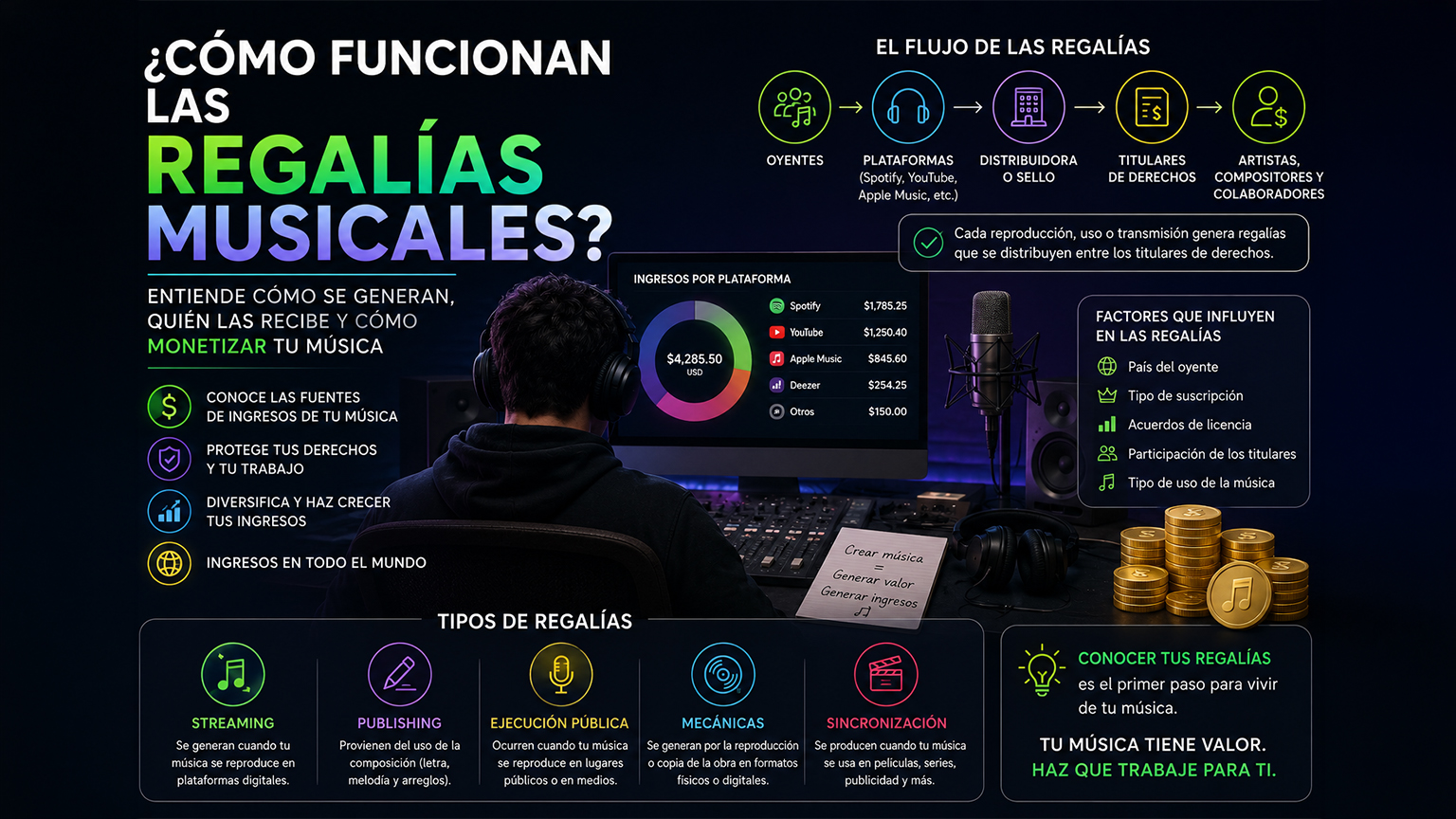
That income can come from different rights:
| Type of income | What generates it | Who usually collects it |
|---|---|---|
| Master royalties | The released recording | Distributor, label or master owner |
| Public performance royalties | Public communication of the composition | PRO or collective management organization |
| Digital mechanical royalties | Interactive reproduction of the composition | Publisher, music publisher, administrator or collective entity |
| Indirect income | Audience, data, concerts, community | Artist, manager or team |
Spotify does not usually pay every independent artist directly. In most cases, Spotify pays rights holders or authorized intermediaries, and they pay the artist according to the relevant agreement.
How Streaming Works on Spotify
When a person listens to a song on Spotify, a chain of data and rights is activated.
The general process works like this:
- The artist, label or team delivers the song to a distributor.
- The distributor sends the release to Spotify with metadata, cover artwork, ISRC, UPC and rights holder information.
- Spotify publishes the song.
- Users stream the song.
- Spotify calculates royalties based on the use of the music in the corresponding market.
- Spotify pays rights holders or authorized intermediaries.
- The distributor, label, publisher or society distributes the money according to registered contracts and percentages.
The key point is this: a stream does not have a universal fixed value. Income can vary by country, user account type, platform revenue, licensing agreements, currency, taxes, type of right and contractual participation.
The Two Main Sources of Royalties
To understand how an artist makes money on Spotify, it is necessary to separate income into two layers.
1. Recording or Master Royalties
These are the royalties related to the final audio uploaded to Spotify.
Example: a specific version of a song that was recorded, mixed and mastered.
These royalties are usually collected through:
- Digital distributor.
- Record label.
- Aggregator.
- Distribution platform.
- Master owner.
If an independent artist owns their master and uses a distributor, they usually receive this income through their distributor dashboard.
2. Composition or Publishing Royalties
These are the royalties related to the musical work: lyrics, melody, harmony and composition.
These royalties may belong to:
- Songwriters.
- Lyricists.
- Producers who have a composition share.
- Publishers.
- Music publishers.
- Publishing administrators.
An artist can perform a song and collect master royalties, but not necessarily collect composition royalties if they did not participate as a songwriter.
Master Royalties
Master royalties are the most visible income for many independent artists because they usually appear in the distributor dashboard.
Who Has the Right to Collect Them?
It depends on who owns the recording.
It may be:
- The independent artist.
- A record label.
- A company that financed the recording.
- A producer with contractual participation.
- Several rights holders divided by percentage.
Simple Example
An independent artist releases a song and keeps 100% ownership of the master.
In that case:
- Spotify pays master royalties to the distributor.
- The distributor deducts its commission or fee, if applicable.
- The remaining balance becomes available to the artist.
Example With a Label
An artist signs with a label that owns or administers the master.
In that case:
- Spotify pays the label or the label’s distributor.
- The label calculates the artist’s share according to the contract.
- The artist receives their percentage after agreed deductions.
Publishing and Composition Royalties
Publishing royalties are often less visible to beginner artists, but they are essential.
A song on Spotify can generate royalties for songwriters even if they are not the main performing artists.
Main Composition Rights
| Right | What it represents | Who can collect it |
|---|---|---|
| Public performance | Public use of the musical work | Songwriter and publisher through a PRO or society |
| Digital mechanical royalty | Interactive reproduction of the composition | Publisher, music publisher, administrator or mechanical entity |
| Synchronization | Use in audiovisual content, advertising, film or series | Owners of the composition and master |
On Spotify, composition royalties can travel through routes that are different from master royalties. This is why an artist may be collecting from their distributor while still leaving money unclaimed on the publishing side.
What Role Does the Distributor Play?
The distributor is the technical and commercial bridge between the artist or label and Spotify.
Its main job is to deliver music correctly to digital platforms.
Distributor Functions
A distributor may handle:
- Sending songs to Spotify.
- Validating metadata.
- Assigning or receiving ISRCs.
- Delivering cover artwork, audio and credits.
- Managing territories.
- Receiving consumption reports.
- Paying master royalties.
- Correcting profile or assignment errors.
- Helping with claims before DSPs.
What a Distributor Usually Charges
A distributor can operate under different models:
| Model | How it works |
|---|---|
| Commission | Keeps a percentage of royalties |
| Annual payment | Charges a fee to keep music active |
| Per-release payment | Charges per single, EP or album |
| Hybrid model | Combines a fee and commission |
| Label model | Includes catalog tools, reports and users |
A distributor does not necessarily replace a music publisher, PRO or publisher administrator. Its main function is related to the recording and digital delivery.
What Role Does a Music Publisher Play?
A music publisher administers composition rights.
Its job is not simply to upload songs to Spotify. Its function is to help songwriters collect publishing royalties and make sure their works are properly registered.
Publisher Functions
A publisher may handle:
- Registering musical works.
- Administering composition splits.
- Claiming publishing royalties.
- Managing mechanical royalties.
- Coordinating with collecting societies.
- Seeking synchronization opportunities.
- Protecting copyright.
- Correcting publishing metadata conflicts.
Difference Between Distributor and Publisher
| Aspect | Distributor | Publisher |
|---|---|---|
| Administers | Recording or master | Composition |
| Mainly collects | Master royalties | Publishing royalties |
| Works with | DSPs such as Spotify | PROs, societies, mechanical entities |
| Benefits | Owner of the recording | Songwriters and publishers |
| Example of income | Streaming of the audio | Performance and mechanical royalties from the work |
An artist who writes their own songs may need both: distribution for the master and publishing administration for the composition.
What Role Does a PRO Play?
A PRO is a performing rights organization. Its function is to collect and distribute royalties when a composition is publicly performed or communicated.
PRO stands for Performing Rights Organization.
International examples include ASCAP, BMI, SESAC, PRS, SACM, SGAE, SAYCO and many other entities depending on the country.
What a PRO Collects
A PRO is usually related to public performance royalties, which may come from:
- Radio.
- Television.
- Concerts.
- Restaurants.
- Bars.
- Digital platforms.
- Streaming.
- Public events.
What a PRO Does Not Always Collect
A PRO does not always collect all digital mechanical royalties or master royalties. This is why registering with a PRO does not mean the artist is already collecting absolutely everything.
This is one of the biggest confusions in the music industry: one stream can generate several types of royalties, but they do not all arrive through the same path.
Practical Example of the Money Flow
Imagine a song called “Midnight Light”.
Participants
| Participant | Role |
|---|---|
| Emma | Performing artist |
| Emma | 50% songwriter |
| James | 50% songwriter |
| Blue Label | Master owner |
| Distributor | Delivers the song to Spotify |
| Publisher | Administers the composition |
| PRO | Collects public performance royalties |
Master Flow
- Spotify pays master royalties.
- The money reaches the distributor or label.
- The label pays Emma according to the contract.
Composition Flow
- Spotify also generates royalties for the use of the musical work.
- Performance royalties may arrive through a PRO.
- Mechanical royalties may arrive through a publisher, society or relevant entity.
- Emma receives 50% of the composition share.
- James receives 50% of the composition share.
In this example, Emma may receive money through two routes:
- As performer or participant in the master.
- As songwriter of the work.
James, even if he does not sing, may also receive money if he is registered as a songwriter.
Does Spotify Pay Per Stream?
Spotify does not work like a store that pays a fixed rate for each play.
The calculation depends on a set of factors, including:
- Subscription revenue.
- Advertising revenue.
- Country where the consumption took place.
- User account type.
- Licensing agreements.
- Catalog share within total streams.
- Type of right.
- Intermediaries involved.
- Contracts between artist, label, distributor and publisher.
That is why two artists with the same number of streams may receive different payments.
Advantages of Making Money on Spotify
| Advantage | Explanation |
|---|---|
| Global reach | Music can be available in multiple countries |
| Audience data | Spotify for Artists allows artists to analyze listeners, cities and playlists |
| Recurring income | A song can continue generating royalties over time |
| Discovery | Playlists, algorithmic radio and recommendations can expand an audience |
| Professionalization | Helps build catalog, history and digital presence |
Disadvantages and Limits
| Disadvantage | Explanation |
|---|---|
| Variable payment | There is no universal fixed rate per stream |
| Dependence on volume | Many streams are needed to generate significant income |
| Rights complexity | Master and composition are collected through different routes |
| Confusing contracts | A bad agreement can significantly reduce the artist’s income |
| Incorrect metadata | Errors in names, ISRCs, splits or credits can block payments |
| Unclaimed royalties | Songwriters without a publisher or complete registrations may lose income |
Common Mistakes Beginners Make
1. Believing Spotify Pays the Artist Directly
In most cases, Spotify pays rights holders or authorized intermediaries. The artist collects through a distributor, label, publisher or society.
2. Confusing Master With Composition
The master is the recording. The composition is the musical work. They are different rights.
3. Not Registering Splits
If there are several songwriters, percentages must be clear before the release.
4. Not Reviewing Credits
Errors in artist names, songwriters or producers can create conflicts and withheld payments.
5. Thinking the Distributor Collects Everything
The distributor usually collects master royalties, but not necessarily all publishing royalties.
6. Not Joining a PRO or Society
If the songwriter is not properly registered, they may leave public performance royalties uncollected.
7. Not Having a Publisher or Publishing Administrator
A publisher can help claim royalties that do not always reach the artist automatically.
8. Releasing Music Without Agreements Between Collaborators
When a song grows, disagreements over percentages can turn into legal problems.
9. Using Beats Without a Clear License
If the beat is not properly licensed, the artist may face monetization issues or claims.
10. Not Reviewing Reports
Royalty reports help detect strong territories, songs with traction and possible inconsistencies.
Comparative Table of Key Players
| Player | What they do | What money they may manage |
|---|---|---|
| Artist | Performs, promotes and develops an audience | Master, composition or both |
| Distributor | Delivers music to Spotify and other platforms | Master royalties |
| Label | Invests in, administers or exploits recordings | Master royalties |
| Publisher | Administers musical works | Publishing royalties |
| PRO | Manages public performance | Performance royalties |
| Songwriter | Creates lyrics, melody or music | Composition royalties |
| Producer | Produces the recording; may have points or a split | Contractual participation |
| Manager | Coordinates strategy and career | Commission on agreed income |
Options an Artist Has to Monetize on Spotify
Option 1: Independent Artist With a Distributor
The artist keeps control of the master and uses a distributor to release music.
This is a common option for emerging artists who want to remain independent.
Option 2: Artist With a Record Label
The label may finance, distribute, promote and administer the catalog.
The artist should carefully review percentages, terms, territories and ownership of the master.
Option 3: Artist With a Distributor and Publisher
The artist uses a distributor for the master and a music publisher or publishing administrator for the composition.
This structure is more complete because it covers more royalty routes.
Option 4: Independent Label With a Distribution Platform
A label can administer several artists, catalogs and reports through a specialized platform.
This model requires greater control over metadata, contracts, splits and internal payments.
Best Practices Before Releasing Music on Spotify
Before publishing a song, it is useful to review:
- Correct artist name.
- Correct artist profile.
- ISRC for each track.
- UPC for the release.
- Complete credits.
- Composition splits.
- Master owner.
- Beat or sample licenses.
- Producer agreements.
- Musical work registration.
- PRO or society affiliation.
- Release strategy.
- Canvas, cover artwork and editorial pitch.
- Delivery dates with enough lead time.
A well-registered song is easier to monetize, audit and protect.
Common Real-World Cases
Case 1: Artist Who Only Collects Through the Distributor
An artist uploads their music and receives master royalties, but never registers their compositions. They are collecting one part, but may be leaving publishing royalties unclaimed.
Case 2: Song With Several Songwriters and No Clear Splits
The song starts to grow, but no one agreed on percentages in writing. This can block publishing registrations, create disputes and delay payments.
Case 3: Artist With a Similar Name to Another Artist
The song appears on the wrong profile. The distributor must request a profile correction from Spotify to avoid audience and reporting confusion.
Case 4: Label That Does Not Organize Metadata
A label with many releases can lose control if it does not properly manage ISRCs, UPCs, contracts, splits and reports.
Case 5: Songwriter Who Does Not Perform
A person wrote part of the song, but does not appear as an artist. Even so, they may have the right to composition royalties if their participation is documented and registered.
Frequently Asked Questions
1. Does Spotify Pay Artists Directly?
Usually not. Spotify generally pays distributors, labels, publishers or management entities, and they pay the artist according to the corresponding agreement.
2. How Much Does Spotify Pay Per Stream?
There is no universal fixed rate. Payment varies by country, user type, platform revenue, licensing agreements and other factors.
3. What Is a Master Royalty?
It is the income generated by the specific recording that was released on Spotify.
4. What Is a Publishing Royalty?
It is income related to the musical composition: lyrics, melody and music.
5. Does the Distributor Collect All My Royalties?
Not necessarily. The distributor usually collects master royalties, but publishing royalties may require a PRO, publisher or collecting society.
6. What Is a PRO?
A PRO is an organization that collects public performance royalties for songwriters and publishers.
7. What Is a Publisher?
A publisher or music publisher administers composition rights and helps collect publishing royalties.
8. Do I Need a Publisher if I Am an Independent Artist?
It is not always mandatory, but it can be useful if you write songs and want to claim publishing royalties more completely.
9. Can I Get Paid if I Am a Songwriter but Not a Singer?
Yes. If you participated in the composition, you may have the right to publishing royalties even if you do not perform the song.
10. What Happens if My Song Appears on the Wrong Profile?
You should ask your distributor to request a profile correction from Spotify.
11. What Are Splits?
Splits are the percentages that indicate how much belongs to each songwriter, producer, artist or rights holder depending on the type of right.
12. Does the Producer Earn Royalties on Spotify?
It depends on the contract. A producer may receive a one-time fee, master points, publishing share or a combination.
13. What Happens if I Use a Beat Bought Online?
You must review the license. Some licenses limit streams, monetization, Content ID, exclusivity or commercial use.
14. Is Spotify for Artists Used to Collect Money?
Spotify for Artists is used to manage the artist profile and analyze data, but it does not replace the distributor or a collection entity.
15. Can UXEM Be Mentioned in This Process?
Yes. A platform like UXEM can serve as an example of a distributor that helps deliver music, manage master royalties and organize processes for artists and labels.
Conclusion
An artist makes money on Spotify through a combination of rights, contracts and registrations. Income does not depend only on the number of streams, but also on who owns the master, who wrote the song, which distributor was used, whether the work is registered and whether an appropriate publishing structure exists.
The central idea is simple: Spotify can generate money from a song, but that money travels through different routes.
The distributor usually handles the master side. The PRO, publisher or music publisher is related to the composition. The artist must understand both paths in order not to depend on only one source of income.
For independent artists and labels, organized management of metadata, contracts, splits, registrations and reports can make the difference between simply releasing music and building a truly monetizable catalog.
In this context, platforms such as UXEM can help organize digital distribution and royalty management, always as part of a broader strategy that includes copyright, publishing, data analysis and sustainable artist development.