
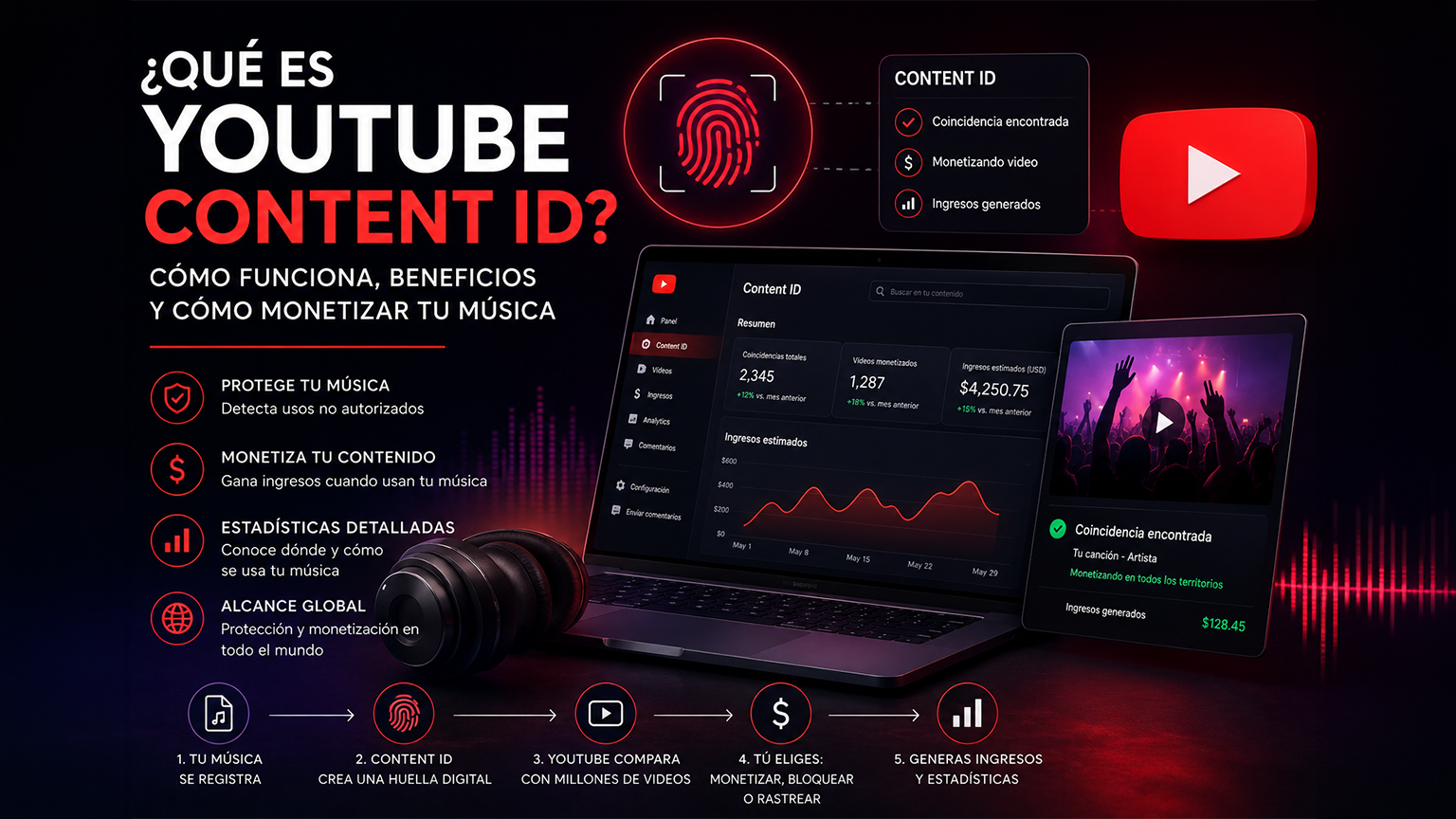
Introduction
Every minute, hundreds of hours of video are uploaded to YouTube. Many of those videos contain copyrighted music, either with permission or without it.
To help rights holders identify and manage the use of their content, YouTube developed Content ID, an automated system that detects songs and other copyrighted materials across millions of videos.
But what exactly is YouTube Content ID? How does it work? Who can use it? And how can artists and record labels benefit from it?
This guide explains everything you need to know about one of the most important copyright management systems in the digital music industry.
Table of Contents
- What Is YouTube Content ID?
- How Does Content ID Work?
- Who Can Use It?
- Content ID vs Copyright Claims.
- How Do You Make Money with Content ID?
- Advantages and Disadvantages.
- Practical Example.
- Frequently Asked Questions.
- Summary.
What Is YouTube Content ID?
YouTube Content ID is an automated copyright management system developed by YouTube that helps rights holders identify, manage, and monetize the use of their content across the platform.
In simple terms:
Content ID automatically compares uploaded videos against a database of copyrighted files registered by rights holders and determines whether there is a match.
When a match is found, the owner can decide to:
- Monetize the video.
- Block it.
- Track its performance.
- Restrict it in specific countries.
How Does Content ID Work?
The system works through a technology known as digital fingerprinting.
Step 1. Content Registration
The rights holder registers:
- Music recordings.
- Music videos.
- Musical compositions.
- Other audiovisual content.
These files are stored in YouTube's Content ID database.
Step 2. Digital Fingerprint Creation
YouTube analyzes the uploaded content and generates a unique digital fingerprint.
This fingerprint contains information such as:
- Audio frequencies.
- Rhythmic patterns.
- Acoustic characteristics.
- Audiovisual features.
Step 3. Automatic Matching
Every time someone uploads a video, YouTube compares it against millions of fingerprints stored in the database.
If a match is found:
- A claim is automatically generated.
- The policies defined by the rights holder are applied.
What Happens When Content ID Finds a Match?
The rights holder can choose one of several policies.
| Action | Result |
|---|---|
| Monetize | Ads generate revenue for the rights holder |
| Block | The video is unavailable in selected territories or worldwide |
| Track | The video remains online while usage statistics are collected |
Example
A creator uses a copyrighted song in a travel vlog.
The rights holder can allow the video to remain online while receiving the advertising revenue generated by it.
Who Can Use YouTube Content ID?
Not everyone has direct access to Content ID.
Typically, access is available to:
- Record labels.
- Music distributors.
- Music publishers.
- Rights management companies.
- Large creators with extensive original catalogs.
Independent artists often gain access through a distributor or a specialized rights management company.
Content ID vs Copyright Claims
These two concepts are often confused.
| Feature | Content ID | Copyright Claim |
|---|---|---|
| Automated | Yes | No |
| Requires legal notice | No | Sometimes |
| Detects matches automatically | Yes | No |
| Can monetize third-party videos | Yes | Generally no |
| Available to everyone | No | Yes |
Content ID
A technology-based automated rights management system.
Copyright Claim
A formal legal request submitted by a rights holder to remove or restrict content.
How Do You Make Money with YouTube Content ID?
Monetization occurs when:
- A user uploads a video containing a registered song.
- Content ID detects the match.
- Ads are shown on the video.
- Advertising revenue is assigned to the rights holder.
Example
A creator uses a song in:
- A vlog.
- A travel video.
- A TikTok compilation.
- A tutorial.
If the song is registered in Content ID:
- The video may remain online.
- The rights holder can receive some or all of the advertising revenue.
What Type of Music Can Be Registered?
Generally:
- Singles.
- EPs.
- Albums.
- Instrumentals.
- Electronic music.
- Film scores.
- Production music libraries.
- Original recordings.
Typically not accepted:
- Content with ownership disputes.
- Unauthorized samples.
- Unlicensed cover versions.
- Works with unclear rights ownership.
Advantages of YouTube Content ID
Automated Protection
Content ID helps detect unauthorized uses at scale.
Additional Revenue Streams
A song can generate income even when used by third parties.
Global Reach
It operates in virtually every country where YouTube is available.
Detailed Analytics
Rights holders can learn:
- Where their music is being used.
- How many views are generated.
- Which countries have the highest activity.
Disadvantages and Limitations
Restricted Access
Not every artist can access Content ID directly.
In most cases, access requires:
- A distributor.
- A record label.
- A rights management company.
False Claims
Sometimes there may be:
- Incorrect matches.
- Ownership conflicts.
- Disputes between rights holders.
It Does Not Replace Copyright Registration
Content ID helps manage content on YouTube, but it does not replace:
- Copyright registration.
- Publishing administration.
- Collective management organizations.
- Rights agreements.
Practical Example for Independent Artists
Imagine you release a song.
Months later:
- A travel creator uses it in a vlog.
- Another user includes it in a compilation.
- A streamer uses it as background music.
If your music is registered with Content ID:
- YouTube can automatically identify those uses.
- You may monetize those videos.
- You receive statistics about how your work is being used.
Many music distributors and monetization platforms offer access to Content ID as part of their services for artists and record labels.
Do Music Distributors Offer YouTube Content ID?
Yes.
Many modern distributors provide:
- Content registration.
- Content ID management.
- Claims administration.
- Revenue reports.
- Royalty collection.
For example, some music distribution and monetization platforms allow independent artists and labels to access these tools without needing to negotiate directly with YouTube.
Frequently Asked Questions (FAQ)
What Is YouTube Content ID?
It is an automated system that identifies copyrighted content on YouTube and allows rights holders to manage or monetize it.
Can Independent Artists Use Content ID?
Usually yes, but most access it through a distributor, record label, or specialized company.
Does Content ID Automatically Remove Videos?
Not always.
Rights holders can choose to:
- Monetize.
- Block.
- Track.
Does Content ID Replace Copyright?
No.
It is a management tool within YouTube and does not replace formal copyright registration.
Can I Make Money If Other People Use My Music?
Yes.
If your music is registered with Content ID and the rights holder chooses monetization, advertising revenue can be generated from videos that use your music.
Summary
YouTube Content ID is an automated system developed by YouTube to identify, manage, and monetize copyrighted content.
Its digital fingerprinting technology allows songs and audiovisual works to be detected across millions of videos uploaded to the platform.
For artists, record labels, and rights holders, it is an important tool because it helps:
- Protect musical works.
- Generate additional revenue.
- Monitor content usage.
- Manage rights on a global scale.
Understanding how Content ID works is increasingly important in an industry where music constantly moves across streaming services, social networks, and digital communities.
Continue Learning
YouTube Content ID is only one part of the modern music monetization ecosystem.
Topics such as royalties, copyright, digital distribution, publishing, and global music monetization are closely connected and can help artists and labels better understand how to protect and grow their catalogs over the long term.