How to Create a Record Label
Introduction
Creating a record label is not just about having a name, a logo, and uploading songs to digital platforms.
A record label is a professional structure that helps artists, producers, and music projects organize releases, manage rights, distribute music, build catalog value, handle royalties, and develop a growth strategy.
Today, it is possible to create an independent label without relying on a major record company, but that does not mean the process is automatic or informal. A label needs clear processes, written agreements, metadata control, release planning, financial administration, and a defined artistic or commercial vision.
This guide explains how to create a record label step by step, what functions it should fulfill, what mistakes to avoid, and what options exist for producers, managers, studios, entrepreneurs, and music teams.
Table of Contents
- What is a record label?
- Who should consider creating a record label?
- How does a record label work?
- Main functions of a record label
- Types of record labels
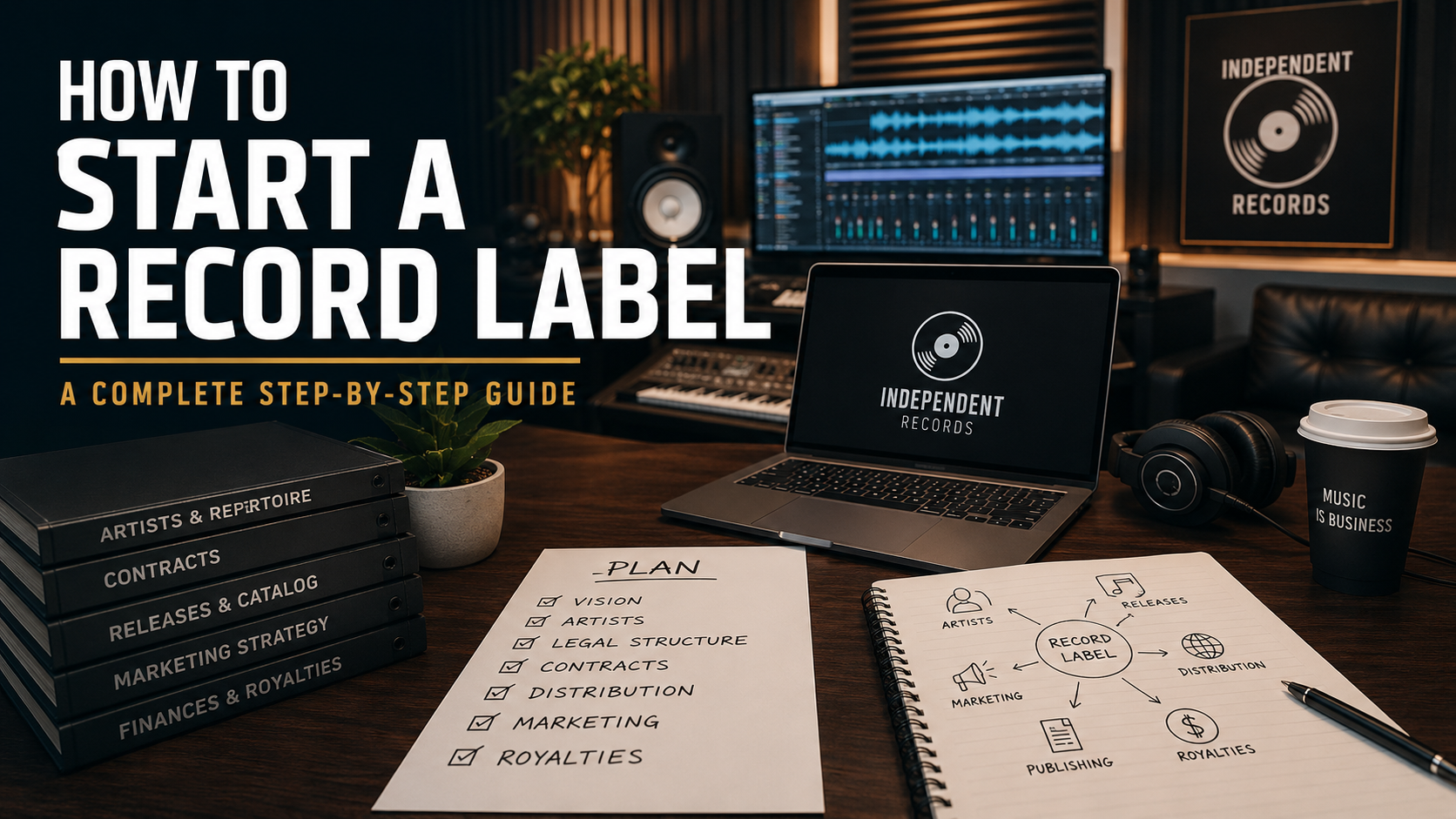
- How to create a record label step by step
- Basic structure of an independent label
- Music rights every label should understand
- Digital distribution and platforms
- Publishing, royalties, and Content ID
- Important contracts and agreements
- Advantages and disadvantages
- Common mistakes
- Practical examples
- Frequently asked questions
- Conclusion
What is a record label?
A record label is a company, brand, or structure responsible for developing, managing, distributing, and promoting recorded music.
Its main function is to work with recordings, also known as masters or sound recordings. This includes songs, albums, EPs, covers, remixes, live recordings, and other music products.
A label may be responsible for:
- Signing artists.
- Coordinating releases.
- Financing recordings.
- Managing catalogs.
- Distributing music to digital platforms.
- Managing metadata.
- Promoting songs.
- Collecting sound recording royalties.
- Protecting content through YouTube Content ID.
- Coordinating marketing campaigns.
- Seeking commercial opportunities.
In simple terms, a label helps turn a music recording into an organized, distributed, and monetizable asset.
Who should consider creating a record label?
Creating a label can make sense for different profiles within the music industry.
Music producers
A producer may create a label to release their own songs, develop new artists, or manage collaborations under a central brand.
Managers
A manager may create a label to organize their artists’ releases, negotiate distribution, and centralize royalty administration.
Recording studios
A studio may create a label to turn its flow of artists and recordings into a managed music catalog.
Entrepreneurs
An entrepreneur may create a label as a cultural, commercial, or technology-driven investment project within the music industry.
Independent artists
An artist may create their own label to release music under a personal brand and maintain greater control over their catalog.
How does a record label work?
A label works as an entity that connects music creation with the market.
The basic flow usually looks like this:
- A recording is created or acquired.
- Ownership of the master is defined.
- Agreements are signed with artists, producers, or collaborators.
- Release metadata is organized.
- The music is delivered to a distributor.
- The distributor sends the content to digital platforms.
- Platforms monetize streams, downloads, or uses.
- Royalties are reported to the distributor.
- The label receives the income.
- The label accounts and pays artists according to the contract.
This process may seem simple, but each step requires control. An error in credits, splits, ISRCs, rights holders, or contracts can cause royalty disputes, blocks, claims, or lost income.
Main functions of a record label
A record label can perform many functions, but the most important ones are the following.
Artist development
The label can help define an artist’s sound, image, narrative, release calendar, and growth strategy.
Music production
Some labels finance or coordinate recording, mixing, mastering, session musicians, producers, and studios.
Distribution
The label delivers music to platforms such as Spotify, Apple Music, YouTube Music, TikTok, Deezer, Amazon Music, and other digital stores through a distributor.
Catalog administration
The label organizes songs, ISRC codes, UPCs, artwork, contracts, splits, release dates, and reports.
Marketing and promotion
It may plan social media campaigns, press, playlists, digital advertising, short-form content, music videos, and public relations.
Royalty management
The label receives income from the exploitation of the master and must correctly account to artists, producers, and other participants.
Content protection
It may manage tools such as YouTube Content ID to identify and monetize uses of recordings in third-party videos.
Opportunity negotiation
A label can seek licenses, sync placements, collaborations, editorial playlists, partnerships, and commercial agreements.
Types of record labels
Not all labels operate in the same way. There are several models.
| Type of label | Main characteristic | Ideal for |
|---|---|---|
| Independent label | Operates outside a major company | Artists, producers, and managers |
| Boutique label | Small and curated catalog | Specific music niches |
| Producer-led label | Built around a producer or creative team | Producers with several artists |
| Management label | Created from an artist management company | Managers with their own roster |
| Studio label | Created from a recording studio | Studios with a steady flow of artists |
| Publishing/distribution label | Combines distribution, publishing, or administration | Teams with professional structure |
| Sub-label | Secondary brand within another company | Catalogs by genre or territory |
How to create a record label step by step
1. Define the purpose of the label
Before thinking about the name, define why the label will exist.
Key questions:
- What type of music will it release?
- Will it work with internal or external artists?
- Will it be a commercial, experimental, urban, regional, electronic, pop, alternative, or catalog-focused label?
- Is the goal to develop artists or manage releases?
- Will it invest in marketing?
- Will it sign artists or only distribute music?
A label without a clear purpose usually accepts any release and ends up with a disorganized catalog.
2. Choose a professional name
The label name should be easy to remember, write, and pronounce.
Before using it, check:
- Domain availability.
- Availability on social media.
- Similar registered trademarks.
- Previous use on music platforms.
- Possible confusion with other labels or artists.
The name should not be too generic or depend on a passing trend.
3. Define the label identity
Identity is not just the logo. It also includes:
- Music genres.
- Visual aesthetic.
- Communication tone.
- Artist profile.
- Editorial values.
- Quality standards.
- Audience type.
- Priority territories.
A strong label is recognized by its criteria. Not every large catalog is a valuable catalog.
4. Decide the legal structure
A label can start as a personal project, but if it will sign artists, receive royalties, or issue payments, it is advisable to have a formal structure.
Common options:
| Option | Advantage | Risk |
|---|---|---|
| Individual operation | Easy to start | Mixes personal and label finances |
| Registered company | More formal | Requires accounting and legal obligations |
| Partnership between founders | Allows functions to be divided | Requires clear agreements |
| Brand within another company | Uses an existing structure | Can create confusion if not separated properly |
The best option depends on the country, taxes, partners, and operating volume.
5. Create internal agreements between partners
If the label has more than one founder, there should be a written agreement.
It should define:
- Ownership percentage.
- Role of each partner.
- Who makes decisions.
- Who signs contracts.
- How profits are distributed.
- What happens if someone leaves.
- Who keeps the brand.
- Who manages the catalog.
Many labels fail not because of lack of music, but because of lack of internal agreements.
6. Define the business model
A label can make money in several ways.
| Income source | Description |
|---|---|
| Streaming royalties | Income generated from plays on platforms |
| YouTube Content ID | Monetization of uses of recordings in videos |
| Licenses | Use of music in campaigns, video games, film, or television |
| Synchronization | Placement of music in audiovisual content |
| Artist distribution | Commission for managing releases |
| Creative services | Production, mixing, mastering, or marketing |
| Publishing | Administration of composition rights, if applicable |
| Merchandising | Sale of products related to artists or catalog |
| Events | Shows, showcases, or live experiences |
A label must know whether it earns through commission, master participation, services, recoupable investment, or a mix of models.
7. Define how you will sign artists
There are different ways to work with artists.
| Model | How it works |
|---|---|
| Simple distribution | The label distributes and charges a commission |
| Master license | The artist keeps ownership but licenses the recording to the label for a period |
| Master assignment | The label acquires full or partial ownership of the master |
| Joint venture | Artist and label share investment, income, and decisions |
| Service agreement | The artist pays for specific services |
| 360 agreement | The label participates in several income sources from the artist |
For new labels, licensing, distribution, or service models are usually more realistic than buying masters or taking on large advances.
8. Organize rights from the beginning
Each release should answer these questions:
- Who owns the master?
- Who composed the song?
- Who wrote the lyrics?
- Who produced the recording?
- Are there any samples?
- Was a beat purchased?
- Is there a beat license?
- Is the song original or a cover?
- Who will collect royalties?
- What percentage belongs to each party?
Do not release music without clarity on these points.
9. Prepare basic contracts
A label needs clear and understandable contracts.
Recommended documents:
- Distribution agreement.
- Master license agreement.
- Composition split sheet.
- Production split sheet.
- Image use authorization.
- Beat or instrumental license.
- Producer agreement.
- Collaboration agreement.
- Founders’ agreement.
- Payment and royalty accounting policy.
A contract should not be confusing. It should explain what is delivered, what is charged, for how long, and under what conditions.
10. Choose a music distributor
To release music on digital platforms, the label needs a distributor.
A distributor delivers content to stores and platforms, processes metadata, receives reports, and pays royalties.
When evaluating a distributor, review:
- Included platforms.
- Commission or fee.
- Delivery time.
- Artist management capabilities.
- Tools for labels.
- Financial reports.
- Support.
- YouTube Content ID.
- Smart Links.
- Pre-Save.
- Access to analytics.
- Takedown policies.
- Ability to manage multiple artists.
A label needs more than uploading songs. It needs catalog management.
11. Create a metadata system
Metadata is the information that identifies a song.
It includes:
- Title.
- Primary artist.
- Featured artists.
- Producer.
- Composers.
- Lyricists.
- ISRC.
- UPC.
- Genre.
- Language.
- Release date.
- Album title.
- Label name.
- Copyright.
- Publishing.
- Explicit or clean version.
- Territories.
- Artwork.
Metadata errors can cause incorrect profiles, YouTube issues, misallocated royalties, and platform confusion.
12. Plan releases
A label should avoid releasing songs without strategy.
A basic calendar should include:
| Stage | Action |
|---|---|
| 4 to 6 weeks before | Confirm song, artwork, contracts, and metadata |
| 3 to 4 weeks before | Deliver to distribution |
| 2 to 3 weeks before | Activate Pre-Save and promotional content |
| 1 week before | Coordinate social media, press, pitching, and final assets |
| Release day | Publish content, links, and campaigns |
| 1 to 4 weeks after | Review metrics, create content, and optimize promotion |
Music should not enter the market without context.
13. Define a payment policy
The label should have a transparent royalty accounting policy.
It should explain:
- How often royalties are paid.
- What commission the label retains.
- What expenses are recouped.
- What reports are delivered.
- What the minimum payout is.
- How taxes or withholdings are handled.
- What happens with disputed royalties.
- How collaborators are paid.
A label’s trust depends heavily on financial clarity.
14. Build a digital presence
A label needs its own channels.
Basic elements:
- Website.
- Corporate email.
- Instagram, TikTok, YouTube, and LinkedIn profiles.
- Catalog page.
- Demo submission form.
- Press kit.
- Own playlists.
- Smart Links.
- Contact database.
- Internal documents.
The goal is not to appear larger than you are, but to create trust and organization.
15. Design a process for receiving demos
If the label will receive external music, it must have clear criteria.
Example process:
- The artist submits a demo through a form.
- The team reviews musical and technical quality.
- Identity, potential, and compatibility are evaluated.
- Additional information is requested.
- The team defines whether distribution, licensing, or collaboration applies.
- An agreement is signed.
- The release is scheduled.
A label should not accept music without reviewing rights, quality, and strategy.
Basic structure of an independent label
A small label can start with a few people, but it must cover essential functions.
| Area | Function |
|---|---|
| Direction | Defines strategy, partnerships, and decisions |
| A&R | Finds artists and evaluates music |
| Operations | Organizes releases, metadata, and deliveries |
| Legal | Reviews contracts and rights |
| Finance | Controls royalties, payments, and reports |
| Marketing | Designs campaigns and content |
| Design | Handles artwork, visuals, and identity |
| Relations | Contacts media, playlists, brands, and partners |
In the early stages, one person may cover several areas. What matters is that the functions exist.
Music rights every label should understand
A label must distinguish between two major types of rights.
Master rights
These are the rights over a specific recording.
Example: a specific recorded version of a song by a particular artist.
The label usually works directly with these rights.
Composition rights
These are the rights over the musical work: lyrics, melody, and composition.
They may belong to composers, authors, publishers, or music publishing companies.
A single song can have:
- One master owner.
- Several composers.
- Several producers.
- A publisher.
- A collective management organization.
- A distributor.
Confusing master rights and composition rights is one of the most common mistakes among new labels.
Digital distribution and platforms
Digital distribution allows the label’s music to reach services such as:
- Spotify.
- Apple Music.
- YouTube Music.
- TikTok.
- Deezer.
- Amazon Music.
- Tidal.
- Instagram/Facebook Music.
- Shazam.
- Pandora, depending on territory and eligibility.
The distributor does not replace the label. The distributor is the technical and commercial channel that connects the catalog with platforms.
The label must handle strategy, rights, artists, and catalog administration.
Publishing, royalties, and Content ID
Publishing
Publishing relates to composition rights, not the recording.
If the label also manages publishing, it must have authorization from composers and understand how collective management organizations, publishers, IPIs, ISWCs, and writer splits work.
Sound recording royalties
These are royalties generated by the use of the master on digital platforms and other media.
They usually arrive through the distributor.
YouTube Content ID
YouTube Content ID allows recordings to be identified in videos and policies such as monetize, track, or block to be applied when appropriate.
Not all recordings are eligible for Content ID. There may be restrictions if they contain unauthorized samples, non-exclusive beats, library music, generic loops, public domain content, or material without clear rights.
Important contracts and agreements
A label should avoid verbal agreements.
Master license agreement
This allows the label to exploit a recording for a specific period without necessarily buying it.
It should include:
- Territory.
- Duration.
- Royalty percentage.
- Label obligations.
- Artist obligations.
- Recoupable expenses.
- Takedown conditions.
- Image use.
- Exclusivity or non-exclusivity.
Split sheet
A document that defines composition or production percentages.
It should be signed before the release.
Distribution agreement
Defines how the label distributes an artist’s music and what commission it charges.
Producer agreement
Clarifies whether the producer receives a one-time fee, royalties, credit, or master participation.
Advantages of creating a record label
| Advantage | Explanation |
|---|---|
| Catalog control | Allows releases to be organized under a proprietary brand |
| Greater negotiation power | An organized catalog can be more valuable than isolated releases |
| Musical identity | The label can build a recognizable artistic direction |
| Centralized administration | Makes reports, contracts, and royalties easier to manage |
| Commercial opportunities | Can open doors to licenses, partnerships, and sync placements |
| Artist development | Allows work on projects over the medium and long term |
| Scalability | A label can grow with new artists and catalogs |
Disadvantages and challenges
| Disadvantage | Risk |
|---|---|
| Legal responsibility | The label may be liable for rights-related mistakes |
| Administrative workload | Metadata, payments, and contracts require discipline |
| Marketing costs | Distribution does not guarantee an audience |
| Conflicts with artists | Disputes may arise over royalties or ownership |
| Slow cash flow | Royalties may take time to be reported and paid |
| Market saturation | A large volume of music is released every day |
| Need for clear criteria | Accepting everything can weaken the brand |
Common mistakes when creating a record label
1. Thinking a label is just a logo
Visual branding helps, but it does not replace contracts, processes, catalog management, and strategy.
2. Releasing music without contracts
This can cause ownership disputes, royalty conflicts, and content takedowns.
3. Not reviewing beats or instrumentals
Many artists use downloaded or purchased beats without understanding the license terms.
4. Confusing master rights with publishing
The label may distribute a recording without owning or controlling the composition rights.
5. Not organizing metadata
Errors in names, credits, or codes can affect profiles and royalties.
6. Promising impossible results
No serious label should guarantee fame, playlists, or specific income.
7. Not separating personal and label finances
This makes payments, taxes, and reports more difficult.
8. Accepting too many artists without operational capacity
A large catalog without control can become a problem.
9. Not providing clear reports
Lack of transparency destroys trust with artists.
10. Not having a marketing strategy
Uploading music is not the same as releasing music.
Practical examples
Case 1: Producer who wants to release several artists
A producer works with five emerging artists and wants to release their songs under one brand.
Recommended approach:
- Create a producer-led label.
- Sign license agreements per song.
- Define production and composition splits.
- Use a distributor with multi-artist tools.
- Plan releases with a calendar.
- Create a shared visual identity.
Case 2: Manager with three artists
A manager represents three projects and wants to centralize royalties.
Recommended approach:
- Create a label or management company structure.
- Do not mix management contracts with master agreements.
- Define separate commissions.
- Keep reports per artist.
- Avoid conflicts of interest.
Case 3: Recording studio with accumulated catalog
A studio has many unreleased recordings and wants to monetize them.
Recommended approach:
- Review artist authorizations.
- Confirm master ownership.
- Create retroactive agreements if possible.
- Prioritize recordings with clear rights.
- Do not upload music without signed permissions.
Case 4: Entrepreneur who wants to invest in music
An entrepreneur wants to finance artists and build catalog value.
Recommended approach:
- Work with legal advice.
- Define whether the investment buys master participation or is recouped as an expense.
- Do not rely only on streaming.
- Create a marketing plan for each release.
- Measure return by catalog, not only by individual song.
Checklist for creating a record label
Before officially launching the label, verify:
- Name defined.
- Domain available.
- Basic visual brand.
- Clear legal or tax structure.
- Founders’ agreement.
- Business model defined.
- Base contracts.
- Royalty policy.
- Distributor selected.
- Metadata system.
- Release calendar.
- Demo process.
- Report templates.
- Active digital channels.
- Artist selection criteria.
Frequently asked questions
1. Do I need a company to create a record label?
Not always at the beginning, but if you will sign artists, receive royalties, and issue payments, a formal structure helps you operate more clearly.
2. Can an artist create their own record label?
Yes. Many independent artists create their own label to release music under a proprietary brand and maintain control over their catalog.
3. What is the difference between a label and a distributor?
The label manages artists, catalog, strategy, and rights. The distributor delivers music to digital platforms and processes royalty reports.
4. Does a record label own the music?
It depends on the contract. It may own the master, hold a temporary license, or only administer distribution.
5. How much does it cost to create a record label?
It depends on the country, legal structure, design, contracts, distribution, marketing, and team. It can start lean, but operating professionally requires investment.
6. What contract does a label need to work with artists?
The most common documents are distribution agreements, master license agreements, split sheets, producer agreements, and image use authorizations.
7. Can a label collect publishing?
Only if it has authorization to administer composition rights. Publishing is different from master royalties.
8. What percentage does a record label take?
It varies by agreement. A label may charge a distribution commission, recoup investment, or participate in master royalties.
9. Can I create a label without signed artists?
Yes. You can start by releasing your own music or developing a small catalog before signing external artists.
10. What is a music catalog?
It is the group of recordings and works managed by a label, artist, publisher, or company.
11. Does a label need YouTube Content ID?
Not always, but it can be useful to protect and monetize recordings on YouTube when the rights are clear.
12. What happens if I upload music with a non-exclusive beat?
There may be restrictions for monetization, Content ID, or licensing. Always review the beat terms before releasing.
13. Can a label work with several genres?
Yes, but it should protect its identity. Some labels use sub-labels to separate genres or catalog lines.
14. What platforms does a label need?
It depends on the distributor, but labels usually seek presence on Spotify, Apple Music, YouTube Music, TikTok, Deezer, Amazon Music, and other relevant platforms.
15. How are royalties paid to artists?
The label receives reports and income, deducts agreed commissions or expenses, and pays the artist according to the signed contract.
Conclusion
Creating a record label is a strategic decision. It can be a strong opportunity for producers, managers, studios, entrepreneurs, and artists who want to build catalog value, organize releases, and participate more professionally in the music industry.
But a label cannot survive on enthusiasm alone. It needs contracts, rights clarity, metadata control, distribution strategy, marketing, transparent reports, and a long-term vision.
The difference between an improvised label and a professional label lies in organization. A well-managed catalog can become a valuable asset; a disorganized catalog can create conflicts, losses, and distrust.
In today’s environment, platforms such as UXEM can serve as an example of how distribution, monetization, Content ID, Smart Links, Pre-Save, publishing, and label tools can be integrated into a broader music operation. The important point is to understand that technology helps, but the foundation remains the same: clear rights, serious processes, and music with purpose.